Showing posts with label Trout. Show all posts

Thursday, December 5, 2013

Fishing With Bears: An Interview With Larry Quilling

Here is the last post in the four part series that started with my investigation into the difference between anadromous and catadromous fish (a difference which you can learn about HERE).  My investigation resulted with me contacting Dr. Joe RichardsonWallace Westfeldt, and Larry Quilling, three people with an enormous quantity of knowledge when it comes to the different fish that fit under both categories.  We've already heard from Dr. Joe and Wallace with a post featuring each of them (Dr Joe's post HERE and Wallace's post HERE), and now it's time to hear from Larry Quilling!  The youth director for Boulder Flycasters and a member of the Board of Directors of Trout Unlimited, whose mission is to conserve, protect, and restore cold water fisheries.  Larry is another one of the expert fisherman that came into my Outdoor Ed class last year to teach us how to fish.  He took us down to Viele Lake, the lake right next to my high school, and we did our best to reel in some dinner!  (Except you would probably not want to eat the fish in Viele Lake, the lake is pretty stagnant and foul.)  I remembered that Larry had mentioned that he had fished for salmon alongside grizzly bears, and so I knew he would be a good person to contact in regards to salmon fishing!  I've reproduced the interview here for everyone to read: there are some pretty awesome pictures within!
Larry Quilling holding a spring Chinook salmon in the Trask River in Oregon!
The Natural World:  In the last few blog posts, we've been talking about anadromous fish, and focusing specifically on the mass migrations of salmon.  What experience do you have when it comes to these mass migrations?

Larry Quilling: I have a good friend whom I visit in Oregon every summer and winter when possible to fish for steelhead trout and salmon.  Here are a few pictures of Tom and I fishing the Oregon coast. Tom has a cabin on the Trask River near Tillamook where I love to fish for spring Chinook. We regularly head to the Columbia River in the late summer where we fish for them as well. The fish I catch in the Trask in late summer are spring spawn fish still held over from the spring run. You will notice their colors morph from the bright silver to dark green and beyond once in the rivers.
Fall Chinook(Kings) from the 2013 Columbia River Trip.
Trask Spring Chinook, 2013
Tom's daughter Margie with a steelhead.
TNW:  I remember you mentioned fishing in Alaska last year.  Do you have any pictures from that?

LQ:  Tom and I went to King Salmon, Alaska two summers ago. The pictures below are from the NakNak River and Katmai National Park.
Fishing with the bears in Katmai. We were fishing just 60-70 yards upstream of these guys. They are all fishing for the sockeye run.
Tom's King from the NakNak.
Me with a a NakNak sockeye.
Patricia and I with a sockeye.
TNW: Tell me more about fishing with the bears! Were they good about maintaining their distance, or did you have any encounters which were a little too close for comfort?

LQ:  Fishing just downstream of the floating bridge at Brooks lodge, I hooked a sockeye.  The commotion and splash alerted another interested party on the other side of the bridge who swam underneath to come see what was going on.
This young griz came to investigate. He is standing right where I was in the previous picture! We took this picture after I landed my fish and got the hell out of there. Rangers were yelling at me the whole time but no one told me the break off my fish.
A picture of my catch....
....and a pose with my fishing partner.

What an incredible opportunity to go fishing so close to wild grizzly bears!  Thanks again for taking the time to talk with me Larry, and we hope to hear from you again soon!  To learn a little bit more about Larry, you can check out his profile on the Boulder Flycasters website HERE!


Unless otherwise noted, the photo credit for all of the photos in the post goes to Larry Quilling.

Saturday, November 30, 2013

Fishing for Salmon on Land and Sea: An Interview With Wallace Westfeldt

As I have mentioned several times now, my investigation into the difference between anadromous and catadromous fish (a difference which you can learn about HERE) resulted in me contacting Dr. Joe Richardson, Wallace Westfeldt, and Larry Quilling with different questions about different fish that fit under both categories. Wallace Westfeldt is the Head Guide at Front Range Anglers (book a trip with him HERE), and last year he came into my Outdoor Ed class to teach us about stream ecology. We also went on a field trip with him to scrounge up some aquatic insects and insect larvae, and I've shared these pictures below the interview.  Wallace had some interesting things to share about fishing for salmon as well, and I decided to make this another post in the anadromous/catadromous series!
Wallace Westfeldt holding a Steelhead in Idaho.  By this point, these incredible fish have already swum 850 miles!
The Natural World: We've been talking about salmon migrations here on the blog for the last few days.  Have you ever had the opportunity to fish and/or see one of these mass migrations?

Wallace Westfeldt: Yes, I have been to Alaska for the Coho (Silver) Salmon migration; in 2012 and 2013. My trips were a little different than the norm. Most people go to the rivers, I was fishing in ocean at Yakutat. Here the Salmon feast on bait fish (mainly herring) to fatten up before going up river. We also spent some time inland at various river inlets where the fish would crowd and compete for going upriver. My fly was called a Seeker. When wet, it looks more like a herring than a herring does. However, I don't think fly choice is an issue. You need to get your hooks in front of a fish and they will eat. They are kind of crazy. In the ocean you are searching for baitballs and/or schools of Silvers. Baitballs are exactly what you would expect: massive spheres (10-30 in diameter) of bait fish swirling and the Salmon attack it.
A female Silver at sea.
Getting solid hook-ups can be challenging. The mouth of a male Silver has an enormous overbite and is cavernous. It is important to get the fly deep in the mouth. When you seem them strike, you can see how aggressive they are for food. Their tiny little eyes can't see the end of their strike, so the mouth opens wide and goes from side to side to get its prey. I don't think they feel the pain of the hook, because when they would pop off at the skiff they would sometimes hit the next hook. However, when they feel the tug of the line they panic and put up an extraordinary battle to get away.
Another female. 
A male: check out the overbite!
TNW:  Where else have you been to catch anadromous fish?

WW: I have also been to Idaho to catch Steelhead trout.  They swam 850 miles. We drove 900. They were in better shape than we were. Bitterly cold fishing, but excellent. When we hook up the fish would weave back and forth in the current, as if irritated, then they would take off. You weren't always sure who caught who.  In truth the pictures I have don't represent how big they can get. Those were the ones I caught.
A steelhead.
TNW:  When you were in Idaho, 850 miles into the salmon journey, how much further did the Steelhead have to swim?

WW: We were near the end of their run by about 50 miles. Because Idaho is so far away from the ocean, they only get one run. Closer locations in Washington and Oregon get several.


TNW: I've noticed the overbite before, what purpose does it serve? It seemed to me that it came about only in the males, and after they were undergoing their pre-spawn transformation, is that correct? Does it play a role in attracting a mate?

WW:  For Cohos, it's an overbite, for Browns, Bows, and Steelhead, it is an underbite, called a kype or kype jaw. As the male gets older there is always some evidence of the kype. However, you are correct that when in spawning mode, it gets more pronounced, as do the colors of Bows, Browns, and Chromers (steelhead nickname). You may also see other changes ... for example I caught a very large Brown once and it was particularly slimy.  Trout have more slime than most fish because their scales are small and soft and don't offer any protection. So the slime is protective.
That's a Brown Trout caught in Mother Lake just west of Loveland. His name is Big Mike, slimy guy in pure spawn mode.
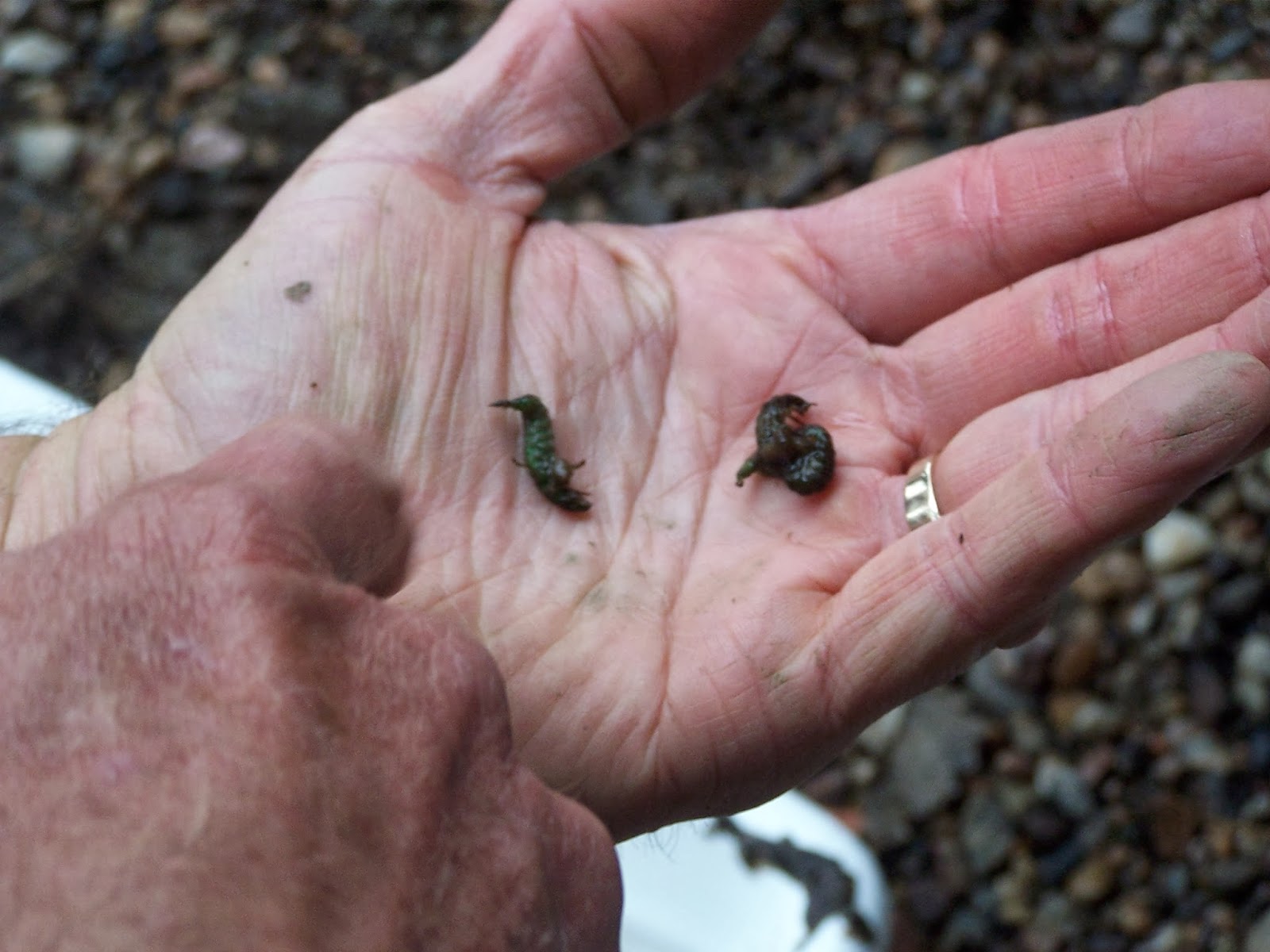
I would like to take this opportunity to thank Wallace for taking the time to answer my questions!  It was very informative, and really interesting!  Thanks again, and make sure you check out his website by clicking HERE!  Before we go though, here are some of the pictures that I took while we were on the field trip with Wallace.


Unless otherwise noted, the photo credit for all of the photos in the post goes to Wallace Westfeldt.
Related Posts Plugin for WordPress, Blogger...