A little while ago, I started a new series all about the Latin and Greek roots in the scientific names of different animals! IN THE LAST POST, we examined animals with the Greek and Latin roots for "one," and today, we are going to kick it up a notch: exactly one notch, to be precise! Today, we are going to examine the roots for the word "two!" Let's begin with the cardinal (i.e. one, two three, etc.) form in Greek! There are actually several roots that work here, but the one most commonly seen in binomial nomenclature is the root "di!" Let's DIve right in!
Our first "di" today is a small flying creature called Dimorphodon, a member of the extinct group of reptiles called pterosaurs. The name "Dimorphodon" comes from three roots, "di," "morph," and "don." "Di," of course, means "two." In this context, the root word "morph" means "form." In mythology and fantasty, a being that can take more than one form is often said to be able to morph their appearance. Finally, the root word "don" is one of my favorites (and is used a whole lot in giving animals their scientific names): it means "tooth." Altogether now: two-form tooth. This name refers to the fact that Dimorphodon actually has two different types of teeth in its jaw. For mammals, that's nothing special, but amongst reptiles, that is pretty rare!
Dimetrodon-another animal with two kinds of teeth! "Di" and "don" still mean the same thing as they did in Dimorphodon (above), but there is a new root in between: "metro." For this root, think of the term "metric." The name "Dimetrodon" actually means "two measures of teeth!" Dimetrodon's two types of teeth would, in the groups that it is ancestral to, one day evolve to become the varied types of teeth that we see in the mouths of mammals! Dimetrodon is more closely related to mammals than it is to any group of living reptile, and all of us mammals did evolve from a Dimetrodon-like ancestor! So remember, if anyone ever tells you that Dimetrodon is a dinosaur, tell them that Dimetrodon actually lived around 40 million years before the first dinosaur ever walked the Earth! That'll show them.
Dimetrodon (left) attacks the primitive amphibianEryops. Much like in the skull of Dimorphodon, you can clearly see the much larger teeth in the front of the skull and the smaller teeth in the back of the skull of Dimetrodon.
Let's travel forward to the Late Cretaceous Period, time of Tyrannosaurus and Triceratops, to meet Didelphodon, a primitive mammal about the size of the living Virginia opossum! As a matter of fact, it is from the opossum that Didelphodon gets its name: "Didelphodon" translates to "opossum tooth," as Didelphis is the genus name for the Virginia opossum and several related species of opossum! In turn, "Didelphis" means "double womb," which presumably refers to the fact that the opossum, like all marsupials, has its internal reproductive tracts where the baby will develop for a bit, and its external pouch, where the baby will develop until full term.
A fourth animal with "two" and "tooth" in its name is Diprotodon! The middle root, "pro," in this name means "forward," like the word "proceed." So the name "Diprotodon" actually means "two forward teeth." A quick examination of the skull of this massive mammal quickly reveals why! Although it looks like it might be some sort of ungodly large rodent, Diprotodon is actually a hippopotamus-sized wombat, the largest marsupial known to have walked the Earth!
Diceratops is a genus of ceratopsian dinosaur that is often considered to actually be a Triceratops. The name, which means "two-horned face," was later discovered to already belong to a type of insect, and changed to the name Nedoceratops. Some other paleontologists believe that Nedoceratops is really the same animal as Triceratops, but I don't really know enough about Nedoceratops to have an informed opinion on the matter. However, paleontologist Jack Horner believes that Nedoceratops is an intermediate growth form between Triceratops and Torosaurus, and since I don't agree with his ideas of Triceratops ontogeny and that I think Triceratops and Torosaurus are definitely distinct dinosaurs, that leads me to suspect that Nedoceratops is more likely distinct, and certainly doesn't bridge the gap between Triceratops and Torosaurus.
The name of Diplodocus, which means "double beam" originates from the two rows of chevron that are on the underside of the animal. This was originally thought to be a feature unique to Diplodocus, a defining characteristic that would set it apart from other closely related sauropods. Since Diplodocus was named by paleontologistOthniel Charles Marsh in the late 1800s, this feature has since been discovered on a number of other sauropods, including Barosaurus, also from the Morrison Formation, like Diplodocus.
Dilophosaurus, one of the stars of the original Jurassic Park movie, gets its name from the two crests on its head. Last time, we met Monolophosaurus, which means "single-crested lizard." Therefore, Dilophosaurus means "two-crested lizard!"
While it is the Greek cardinal root for "two" that is used most frequently in binomial nomenclature, it is the Latin root that is most often used for multiples (i.e. once, twice, thrice, etc.), the root "bi." You can probably think of several words right off the top of your head that use this root! In fact, the word "biped," used to describe creatures that walk on two feet (as opposed to, say, a quadruped), comes from the two roots "bi" and "ped," with "ped" meaning "foot" in Latin. So literally, "biped" means "two feet!" Let's look at a few more!
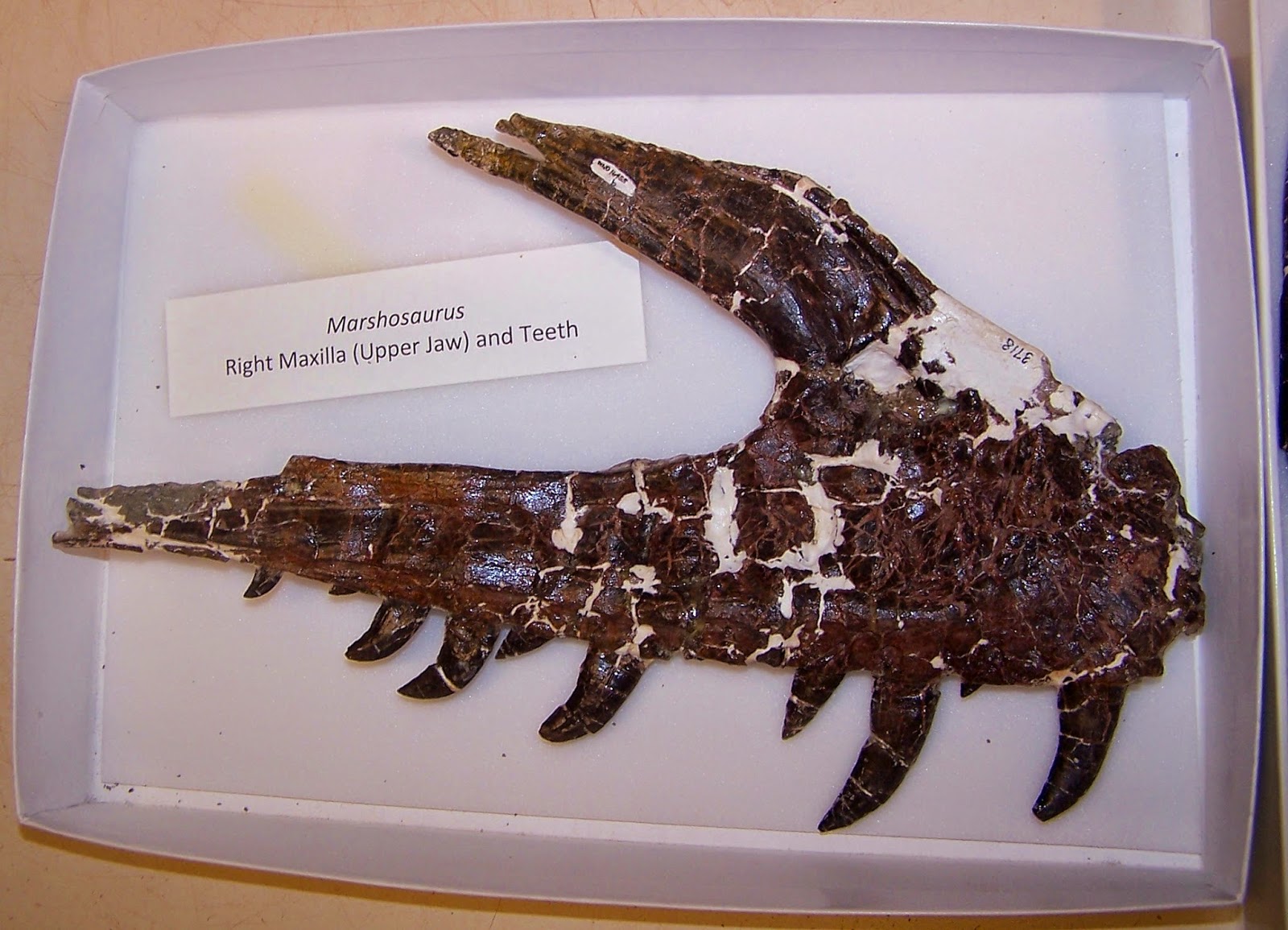
Marshosaurus bicentesmus - A theropod dinosaur from the Morrison Formation (one who has received "Full-Post Status," as you can see by clicking HERE). The exact relationships of Marshosaurus to other theropods isn't exactly clear, but some people think it might even be some sort of primitive coelurosaur, while others think it is more closely related to Megalosaurus and kin. Regardless of its phylogenetic relationships, the name of Marshosaurus is quite exciting! The genus name "Marshosaurus" honors the famous paleontologist Othniel Charles Marsh, who did a lot of work in the Morrison Formation. The species name "bicentesmus" refers to the fact that the species was described in 1976, the bicentennial of the United States. The bicentennial is, of course, a 200 year anniversary, and the "bi" in the name distinguishes a 200 year anniversary from a 100 year anniversary, or a centennial.
Here are two shots of a specimen of Marshosaurus that were on display in the lab at the Denver Museum of Nature and Science last year. This first picture is the right maxilla, which would have made up part of the front section of the animals snout.
Here we have more of the same specimen, on display at the same time and the same place. You can see several vertebrae and ribs in this shot.
Baeolophus bicolor - This is the scientific name of the tufted titmouse, a small woodland bird native to much of the eastern half of the United States. These little birds live in holes in trees that have been abandoned by woodpeckers, and are closely related to chickadees and, of course, the other titmice. I couldn't figure out what the genus name "Baeolophus" means, but it is pretty apparent that the species name "bicolor" refers to the fact that this little bird is gray on its back, and white on its underside. Some of the other species in the genus, such as the juniper titmouse (Baeolophus ridgwayi), are simply all gray.
Diceros bicornis - Here we have the scientific name of the black rhinoceros, a "Critically Endangered" species of African rhino. According to some sources, the black rhino often prefers to eat Acacia leaves, presumably employing its prehensile upper lip to avoid the plants thorns. The black rhino has pretty poor vision, with much better auditory and olfactory sensing capabilities. Humans are easily the most dangerous threat to the black rhinoceros, with lions and the spotted hyena occasionally taking young black rhinos as prey, and even more rarely attacking adults. The scientific name of the black rhinoceros literally means "two-horn two-horn." As we have already established, both "di" and "bi" are roots that mean two. Both "ceros" and "corn" are roots that refer to horns: think "Triceratops" for ceros (three-horned face), and "unicorn" for corn (one-horn).
The horns and frills of Triceratops. The tube-like crest of Parasaurolophus. The two crests of bone on Dilophosaurus. The sail on Spinosaurus. What function do these various bells and whistles that adorned these so-called "Terrible Lizards" serve? For years, most paleontologists assumed that they were for the sole purpose of combat, be it against predators, or the inter-specific variety. But now, more and more paleontologists are looking to birds to answer the question of functionality when it comes to these bony dinosaurian protuberances.
But what, specifically, about birds is it that is helping paleontologists figure out the purpose of these structures? It all boils down to an interesting phenomenon called "sexual selection." Most people are familiar with the term "natural selection." Popularized by Charles Darwin, natural selection essentially states that animals that are unfit to survive and reproduce in a given environment will die, and will be unable to add their genes to the genepool. (Certainly an oversimplified definition, but you get the picture.) Sexual selection, on the other hand, is a mode of natural selection, and introduced by Charles Darwin, as well. Sexual selection states that some individuals in a given population will be more likely to breed than other individuals will because they will stand out above the rest of the population. There are many ways of doing this, and birds are but one example. Horns and antlers are one instance: typically, if an animal has larger horns or antlers, they will be able to not only fend off predators better (i.e. natural selection), but they will be more likely to be able to fend off other males, and be more likely to be picked for the females (i.e. sexual selection). In many animals, form overcomes functionality in this endless quest for a mate, especially on insular (or island) populations. One of my favorite examples of this is the birds of paradise from New Guinea, as you can see in the video below.
That's all well and good, but how does that apply to the dinosaurs that we were talking about above? Well, for years, paleontologists assumed that dinosaurs like Triceratops and its relatives were using their horns and frills to fight off predators. Well, for Triceratops, that makes sense: with forward-facing horns and a two-inch thick frill, fighting off Tyrannosaurus doesn't seem that far out of the realm of possibility. However, upon examination of many of the other relatives of Triceratops (collectively called ceratopsian dinosaurs), you can see that, perhaps, not all of these frills and horns evolved to fight off predators. Below we have just one example. The picture you see is of a skull that below belongs to a ceratopsian dinosaur called Einiosaurus. As you can see, it does not seem anywhere near as well equipped for fighting off predators as Triceratops does. For example, its frill has a pair of massive holes in it. Furthermore, of its three horns, one points downwards, and two point towards the sky at about a forty-five degree angle. Unless Einiosaurus was being attacked by giant woodchuck-like, burrowing dinosaurs, or being dive-bombed by Tyrannosaurs in F-14s (as seen in Calvin and Hobbes!), it is difficult to see how Einiosaurus might have defended itself against its predators using its frill and horns. Another analogy I like to make is this: if you are a knight going into battle, you don't necessarily want to have a pair of giant holes in your shield, and your sword bent and pointing towards the ground.
So how does this all tie in to Stegosaurus? Well, a same sort of discussion has centered around Stegosaurus for many years. Were the plates used for defense? Or were they used for something else? First let's address the idea of defense. IN THE PREVIOUS POST, we discussed the thagomizer, the group of tail spikes, on the rear end of Stegosaurus. These tail spikes were almost certainly used to fend off enemies, and seemed to have done a very good job, too. So, if you think about it, if you were to cover a stegosaur in these spikes, it would be almost impervious to attack, right? Well, what's interesting is that, early in stegosaur evolution, many of these animals actually did have a lot more spikes than Stegosaurus did. As a matter of fact, the plates of Stegosaurus are nothing more than heavily modified spikes! Below, we have a few more primitive stegosaurs, all of whom demonstrate the fact that, prior to Stegosaurus, many of the plates were actually spikes!
So if the spikes were better than plates were at defending an animal against predators (which is the only logical conclusion that I think people can draw from the data at hand), then why did some of the stegosaurs change? For many years, paleontologists thought that they had a pair of answers to this interesting dilemma. The first was the idea that perhaps Stegosaurus used its plates as a thermoregulaton device. If the animal was too cold, then it could turn its body so that its plates faced the sun, maximizing its surface area that was facing the sun, and enabling it to warm up quicker. The reverse would have also worked: when it became to hot, Stegosaurus could turn perpendicular to the sun, minimizing the surface area that was absorbing the sun. Another theory was that Stegosaurus could flush blood to the plates, turning them a brighter color. This could have either frightened off enemies, or instead it could have been used to attract a mate.
These two ideas seem fairly good in theory: however, much like the skull of Einiosaurus, there are a few massive holes in this logic. If Stegosaurus used its plates as a thermoregulatory device, why do close relatives of Stegosaurus have very different plate shapes, or sometimes fewer plates altogether? If there was one design that these animals used to warm up or cool down, one would imagine they would all converge on the same design. But they didn't, which casts some serious doubt on the whole thermoregulatory idea.
There are two theories that seem to hold the most water today. The first one has the same general idea that the "flushing the plates full of blood" idea has: make yourself more noticeable, as these plates were very impressive looking structures. And, since they alternated down the back (SEE THE FIRST STEGOSAURUS WEEK POST HERE), then a side-on look of Stegosaurus would have been a very impressive sight, indeed! Other stegosaurs of the opposite sex would undoubtedly think so, and these plates probably served a large role in attracting a mate! Predators might have thought that the side-on view was impressive, too, and this might have caused them to think twice about attacking Stegosaurus. It also might have caused other members of the same species to back down, too, in cases where inter-specific combat might have otherwise come into play. As Matt Mossbrucker, the director and curator at the Morrison Natural History Museum likes to say, "think a skinny kid in a puffy coat."
Finally, the plates might have helped stegosaurs to differentiate from one another. This is a tactic often used in animals today (again, the birds of paradise and many other birds: see the last paragraph of our post on the cichlids of the Great African Rift Lakes HERE), and is thought to have been a tactic used by many extinct animals, as well. For example, the various horns and frills of the ceratopsian dinosaurs (like Triceratops and Einiosaurus that we were talking about before) are now thought by many paleontologists to have been used to tell each individual species apart, and its possible that that is what the stegosaurs were doing, too.
Want to learn more about Stegosaurus? Well, check out the Homebase for Stegosaurus WeekHERE to partake in more of the festivities!


+and+Ribs+on+Display+at+the+Denver+Museum+of+Nature+and+Science+in+Denver+Colorado+Photo+Credit+Zack+Neher.JPG)

