William Randolph Hearst was a man who, long story short, had a ton of money. Tours of his house near San Luis Obispo in California are simply fantastic, but it makes your own home feel enormously small. Unless of course, you have a mansion, in which case you're probably all right!
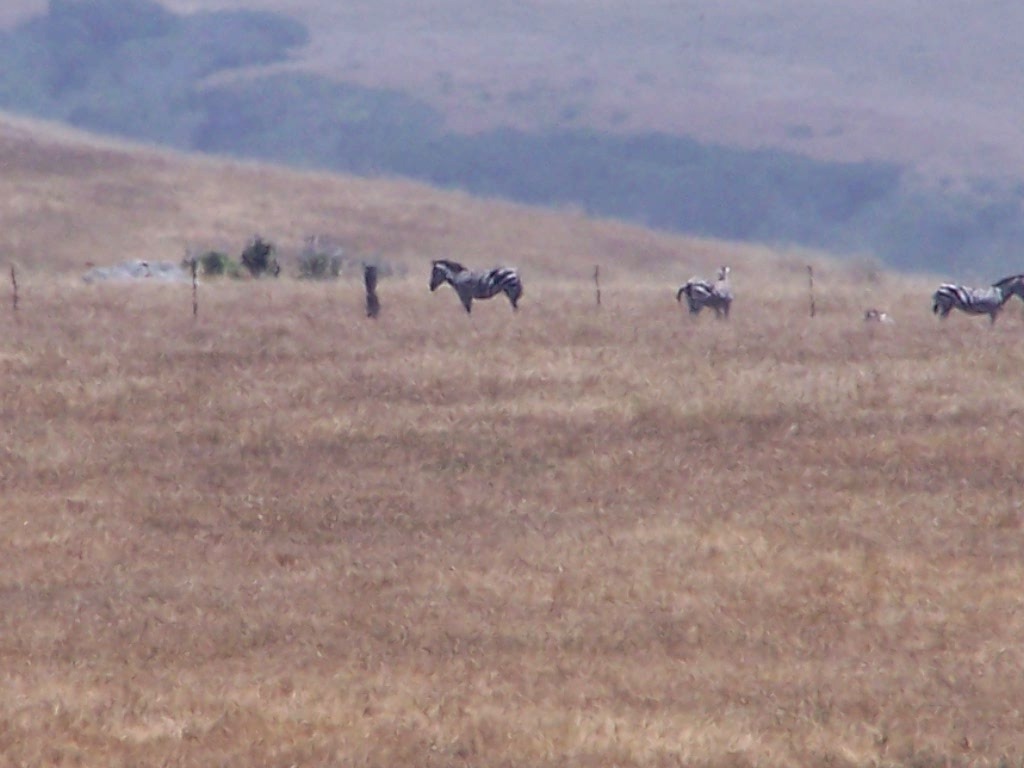
Anyways, Hearst even had a zoo on his grounds! Most of the animals that he used to have there are dead or have been given to other zoos, but some remain, like a small group of zebras! Here are some pictures that I took of them. Unfortunately they were really far away, but you can still tell what they are!
Showing posts with label Zebra. Show all posts
Friday, February 8, 2013
Sunday, August 5, 2012
Animal Spotlight: The Okapi
For years, Europeans who traveled to Africa heard tell of a mysterious rainforest animal that they came to refer to as the "African Unicorn." Apparently, Sir Harry Johnston, the British governor of Uganda, rescued a small group of the native inhabitants, often called the pygmies, from a foreign show person, who, sadly, was most likely going to use his abductees for a circus or freak show. Upon their rescue at Johnston's hand, they repaid him by giving him information about the animal.
Now we know the animal as the okapi, or Okapia johnstoni, named in honor of Sir Harry Johnston. Despite the zebra-like stripes on its tail, the okapi is not all that closely related to the zebra, and is actually a very close relative of the giraffe. Although they may not look super similar, they both have ossicones on their head, similar to the base of DEER antlers. Ossicones are not only possessed by both the okapi and the giraffe, but also by extinct relatives of both, such as Sivatherium and Climacoceras.
The okapi is listed as "NEAR THREATENED" by the IUCN. Honestly, I was surprised that it wasn't at least listed as "VULNERABLE," and "ENDANGERED" or worse would not have surprised me at all, given its reclusive nature, its beautiful pelt, and the very fact that humans didn't have much proof of its existence until 1901, when Sir Henry Johnston sent back a carcass to England. I suppose, however, that its reclusive nature likely helps it to evade human influences a great deal, coupled with the fact that the rainforest that it inhabits is not too heavily tread. And I guess the fact that it was really made known to science only a little more than one hundred years ago couldn't have hurt either, as it would be soon entering into an age when nature was offered greater protection than in the 1800s.
Like the COELACANTH and THE MOUNTAIN PYGMY POSSUM, the okapi is often referred to as a "LIVING FOSSIL." Its habitat consists of montane rainforests in the Central African Republic (CAR) and the DEMOCRATIC REPUBLIC OF THE CONGO (DRC).
Now we know the animal as the okapi, or Okapia johnstoni, named in honor of Sir Harry Johnston. Despite the zebra-like stripes on its tail, the okapi is not all that closely related to the zebra, and is actually a very close relative of the giraffe. Although they may not look super similar, they both have ossicones on their head, similar to the base of DEER antlers. Ossicones are not only possessed by both the okapi and the giraffe, but also by extinct relatives of both, such as Sivatherium and Climacoceras.
The okapi is listed as "NEAR THREATENED" by the IUCN. Honestly, I was surprised that it wasn't at least listed as "VULNERABLE," and "ENDANGERED" or worse would not have surprised me at all, given its reclusive nature, its beautiful pelt, and the very fact that humans didn't have much proof of its existence until 1901, when Sir Henry Johnston sent back a carcass to England. I suppose, however, that its reclusive nature likely helps it to evade human influences a great deal, coupled with the fact that the rainforest that it inhabits is not too heavily tread. And I guess the fact that it was really made known to science only a little more than one hundred years ago couldn't have hurt either, as it would be soon entering into an age when nature was offered greater protection than in the 1800s.
Like the COELACANTH and THE MOUNTAIN PYGMY POSSUM, the okapi is often referred to as a "LIVING FOSSIL." Its habitat consists of montane rainforests in the Central African Republic (CAR) and the DEMOCRATIC REPUBLIC OF THE CONGO (DRC).
Labels:
Africa,
CAR,
Coelacanth,
Deer,
DRC,
Endangered,
England,
Europe,
Giraffe,
IUCN,
Living Fossil,
Mammal,
Mountain Pygmy Possum,
Near Threatened,
Okapi,
Ossicone,
Uganda,
UK,
Vulnerable,
Zebra
Tuesday, July 3, 2012
The Biggest Carnivorous Dinosaur Part 2: Carcharodontosaurus Vs. Spinosaurus
As I promised yesterday, today we are going to take a closer look at Carcharodontosaurus (kar-kar-o-DON-to-SAUR-us). Carcharodontosaurus was a relative of Colorado's own Allosaurus. However, Carcharodontosaurus was four times larger, and found in Egypt, Morocco, Algeria, Libya, and Niger. At around 46 feet long, Carcharodontosaurus was similar in size to yesterday's Giganotosaurus (pronounced jig-a-NOTE-o-saur-us), and longer than Tyrannosaurus, though Tyrannosaurus was undoubtedly much bulkier. Regardless, Carcharodontosaurus was a monster-sized killer, and almost certainly had a monster-sized appetite to match. It is almost a certainty that such an animal would have a fairly large territory, and would have needed to eat a great deal to maintain its fast metabolism, similar to your average teenage dude.
Clearly, such a large predator had little competition from other carnivorous dinosaurs. Or did it? As a matter of fact, 95 MYA, North Africa was home to not one, but two monster-sized killers, Carcharodontosaurus, and the even longer, 50 foot (15 meter) Spinosaurus. (Some not so conservative estimates even place the maximum size for Spinosaurus as 60 feet (18 meters) in length, but this does seem extreme.)
Now, in the modern day, predators can inhabit the same area. Take the plains of Africa, for example; in many places, lions, leopards, cheetahs, wild dogs and hyenas all inhabit the same area. There is a clear hierarchy amongst the animals, and each seems to get enough to eat. However, this is partly because each animal exploits a slightly different set of resources, so contact amongst them is less frequent than if all five of the large carnivores all hunted the same animal, say, the Thomson's Gazelle. This is a phenomenon known as resource partitioning, and it occurs all over the place in nature, arguably one of the most important factors involving ecology and evolution. Scientists believe that a similar sort of partitioning took place between the two mega-carnivores of Mid-Cretaceous North Africa, with Carcharodontosaurus being a terrestrial carnivore, while Spinosaurus took to the water. We will conclude "The Biggest Carnivorous Dinosaur" trilogy tomorrow with a look at the environment Spinosaurus was able to so successfully exploit.
Clearly, such a large predator had little competition from other carnivorous dinosaurs. Or did it? As a matter of fact, 95 MYA, North Africa was home to not one, but two monster-sized killers, Carcharodontosaurus, and the even longer, 50 foot (15 meter) Spinosaurus. (Some not so conservative estimates even place the maximum size for Spinosaurus as 60 feet (18 meters) in length, but this does seem extreme.)
Now, in the modern day, predators can inhabit the same area. Take the plains of Africa, for example; in many places, lions, leopards, cheetahs, wild dogs and hyenas all inhabit the same area. There is a clear hierarchy amongst the animals, and each seems to get enough to eat. However, this is partly because each animal exploits a slightly different set of resources, so contact amongst them is less frequent than if all five of the large carnivores all hunted the same animal, say, the Thomson's Gazelle. This is a phenomenon known as resource partitioning, and it occurs all over the place in nature, arguably one of the most important factors involving ecology and evolution. Scientists believe that a similar sort of partitioning took place between the two mega-carnivores of Mid-Cretaceous North Africa, with Carcharodontosaurus being a terrestrial carnivore, while Spinosaurus took to the water. We will conclude "The Biggest Carnivorous Dinosaur" trilogy tomorrow with a look at the environment Spinosaurus was able to so successfully exploit.
| A fantastic visual representation of resource partitioning amongst large herbivorous mammals in Africa. The giraffe, the zebra, and the wildebeest will all inhabit the same area and eat plants, but the types of plants can differ. Photo Credit: Ted and Gail Neher |
Labels:
Africa,
Allosaurus,
Carcharodontosaurus,
Colorado,
Competition,
Cretaceous,
Dinosaur,
Egypt,
Giganotosaurus,
Giraffe,
Morocco,
Record Breaker,
Resource Partitioning,
Tyrannosaurus,
Wildebeest,
Zebra
Subscribe to:
Posts (Atom)