Showing posts with label Swahili. Show all posts

Monday, December 9, 2013

Damu the Greater Angle-Winged Katydid!

A few months ago, I looked up at the dorm room wall and there was a katydid perched there!  I captured him and put him in a container for a week!  I learned a little bit about katydids, so put your listening ears on!
Damu in his container.  "Damu" means "blood" in Swahili, and for good reason.  This little insect was a bloodthirsty demon, I tell you what.  Which is a joke because it eats leaves.  Ha.
I figured out that Damu was probably a greater angle-winged katydid (Microcentrum rhombifolium), native to the southwestern and eastern United States.  The adults are only around from between July and October, except in Florida, where the higher year round temperatures allow the species to live year round.

The greater angle-wing is pretty large as insects go (especially here in Colorado), and looks quite cool!  As you can probably tell from the picture below, the katydid has evolved to superbly mimic its surroundings: i.e., the leaves of trees!  This makes the katydid one of my Top Ten Favorite Camouflagers, one of four insects to make the cut!

Top Ten Favorite Camouflagers
By Zack Neher

1.  Octopus
2.  Walking Leaves
3.  Leafy Sea Dragon
4.  Katydid
5.  Ghost Mantis
6.  Harry Potter Under the Invisiblity Cloak
7.  Arctic Fox
8.  Walking Stick
9.  Optimus Prime
10.  Ptarmigan
11.  Leaf-Tailed Gecko


If you live in much of the United States (refer to the map below), you can probably see the greater angle-winged katydid!  Or, at least, hear it!  I know for me personally, once I knew what I was listening to, I heard them ALL the time!  Click the link to hear a sound clip of the male making its distinctive clicking sound!  (Damu made these sounds, which is why I am almost positive of him being a male).

Male Katydid Clicking Sounds

Damu is sadly no longer with us: I kept him for about a week, and decided to let him go.  He spent a lot of time making his clicking sounds (which are surprisingly loud for a critter of his size), especially at night when we were trying to sleep.  It got quite annoying, and I wanted him to be free, so I released him from his prison.  Plus he pooped WAY more than an insect of his size should.

I caught another katydid later on, this time a female.  You could tell that Damu Mbili (Damu II in Swahili) was a female because she never clicked and had an ovipositor, an organ possessed by some animals to aid in egg laying.  She died in the middle of October, right around when you would expect these katydids to pass away, though I did hear male katydids clicking away intermittently through the 27th of October.  Here are a few pictures.
Check back soon for our next post, where we look at some insects that I saw at my recent visit to the San Diego Zoo, many of which are expert camouflagers!

Works Referenced:

Monday, December 10, 2012

23-Fact Tuesdays: Polar Bear Celebrations, Eccentric Artists, and Unicorn Horns!

Welcome to our third "23-Fact Tuesday" which are never on Tuesdays.  I believe that this one is actually closer to a Tuesday than we ever have been before, however, so that's got to count for something!  I'd also like to thank Mona Kamath for her help on this post!  Enjoy!

1.  Despite the fact that polar bears are generally solitary, they gather annually in places like the city of Churchill in Manitoba, Canada, where they congregate together prior to the freezing of the sea ice.  When they gather in groups like this, the group is called a "Celebration." 

2.  The eccentric and incredibly odd (though undeniably gifted) artist Salvador Dalí had a pet ocelot named Babou.  He also had a pretty righteous mustache, if I do say so myself.

3.  In 1663, the German scientist Otto von Guericke "reconstructed" the mythical unicorn using the fossilized bones of a mammoth, a woolly rhinoceros, and the horn of a narwhal.  This reconstruction managed to legitimately fool some people, including Gottfriend Wilhelm Leibniz, the famous German philosopher and mathematician, who reportedly was dubious about the existence of the unicorn prior to this "reconstruction," but was convinced by Guericke's "fossil."  

4.  From wing tip to wing tip, Hatzegopteryx measured an astonishing 46 feet!

5.  Gasosaurus, a dinosaur that was described in the year 1985, was named "Gas-Lizard" because it was discovered by a Chinese gas-mining company.

6.  In order to hover and move in any direction, the hummingbird, often nick-named "nature's helicopter" moves its wings in a figure-eight pattern, as opposed to the up-and-down motion typical of other birds.

7.  Cotylorhynchus, one of the largest pelycosaurs, is quite possibly the funniest-looking extinct animal I have ever, ever seen.  It was also discovered by my 9th grade Language Arts teacher's great great uncle, J. Willis Stovall, a famous paleontologist

8.  One of the elephants at the Cheyenne Mountain Zoo is named Kimba, which means "Poop" (I used the nicer term for what the word actually means there) or "Corpse" in Swahili.

9.  Speaking of poop, fossil poop is known as a "coprolite."

10.  The acrobatic margay can rotate its ankles 180 degrees, which allows it to descend tree trunks head-first and hold on to branches with either their front or back paws.

11.  The white-tailed deer is named for the white patch on its rump and tail, while the mule deer is named for the fact that its face resembles that of a mules.

12.  About a third of the extant mammalian species are rodents.

13.  Hopping, the method of locomotion preferred by the kangaroos, is actually much more efficient than walking.  Of course, this is only the case if you have evolved in that fashion.  It wouldn't just be more energy efficient if we started hopping around everywhere.  

14.  Although you often hear people mention the "saber-toothed tigers," this is actually a bit of a misnomer, due to the fact that the saber-toothed cats to which they are referring to are not actually tigers, and are simply just cats.  

15.  The sweat of the Hippopotamus, is red or pink, leading people to aptly refer to it as "blood-sweat."

16.  Despite the fact that the polar bear has white fur, the color of its skin is the complete opposite: jet-black.  Talk about Yin/Yang right there.

17.  Island dwarfism is suspected to have occurred in one of our human relatives, Homo floresiensis, who inhabited the island of Flores in Indonesia up until around 12,000 years ago.  The nick-name for this ancient human is "The Hobbit." 

18.  The word "Mona" means "monkey" in Spanish.  Sure would suck if that was your name now wouldn't it!

19.  In Hindu culture, owls are a sign of bad luck.  That double sucks if you are Hindi and terrified of birds.

20.  Speaking of owls, due to the fact that they have binocular, or stereoscopic, vision (unlike other birds of prey, who have an eye on each side of its head), they have evolved the ability to turn their heads around 270 degrees in either direction.  Must be tough for them to crack their necks.

21.  Despite the fact that the creature in the picture below looks like a raccoon, it is not: that, my friends, is the raccoon dog!

22.  The tusks of the elephants are actually greatly elongated incisor teeth.  For reference, tap your front two teeth on the top or bottom of your mouth, it doesn't matter which, they are the same.  Those are your incisor teeth, you have two on each side of your mouth, eight all together.  

23.  In the narwhal, however, the tusk is their canine teeth, which (at least in our mouths) are the teeth right next to our incisors, towards the outside of our mouths. 

Wednesday, August 22, 2012

The Sounds of Star Wars

The dog that was once owned by George Lucas has gone down in history in more ways than one.  One very famous example stems from the dogs name: Indiana.  This inspired the first name of the swashbuckling adventure hero "Indiana Jones" from the film franchise of the same name.  Another very important legacy of Indiana (the dog) stems more from appearance.  Apparently, the idea for Chewbacca, the lovable Wookiee from the Star Wars franchise, came to Lucas when he saw Indiana sitting up in the passenger seat of Lucas's own car!  In fact, the name "Chewbacca" apparently is derived from the Russian and Ukrainian word "собака," which means dog.

Ben Burtt, the sound editor for all six Star Wars movies, recorded a number of bear sounds for the purpose of creating Chewbacca's speech.  Along with bears, cats such as the lion and the mountain lion were also recorded.  Camels were used in addition to these fiercer companions.  These were by no means the only contributions by the animal world to the sounds of Star Wars, however!  For example, when it came to the patrons in the Mos Eisley Cantina in Episode IV: A New Hope, many different tactics were utilized.  Synthesized Latin and chopped-up Swahili served for two of the customers, but animals were used as well.  One patron's laughter stemmed from a hippopotamus, while anothers came from a spring peeper tree frog.

That's not all when it comes to the Cantina scene, however!  Ponda Baba was the Aqualish alien, below, who, along with his friend Dr. Evazan, picked a fight with Luke Skywalker and Ben Kenobi.  He was "voiced" by a walrus.  Meanwhile, besides "dogs growling and bats squeaking," the "laughter" of hyenas was also used for the laughter of some of the Cantina's other patrons. 


Here are some more sounds, and what kind of animals contributed to their creation:

Geonosians:  Here is what Matthew Wood, the actor who brought the voice of the famous and much-loved General Grievous to life, has to say regarding the sounds made by the Geonosians:

"I recorded the mating calls of penguins as they came back from the Antarctic to little Phillip Island in Melbourne.  Other sounds came from when I was up in the rain forest; I was in a flying fox area, and they let me get close to these two flying foxes.  One of them had a banana, but the other one wanted some of it, so they started fighting.  They were really mad, and I recorded that whole thing.  So, for the Geonosians, Ben [Burtt] combined mating penguins and fruit bats fighting over a banana."

The penguins that he is referring to are the korora, commonly called the little blue penguins, discussed in a recent post.  They would also not have been returning "from the Antarctic," as these birds, the smallest known penguin, past or present, are not cold-weather birds, and really stick pretty close to Australia.

Boga:  One of my absolute favorite characters (yes, I know, technically she is just an animal, but still) was voiced by a combination of one of my favorite REAL animals, the Tasmanian devil, along with a few yelps from dogs and coyotes.

Wampa scream: An elephant bellow, overlied by the squawk of a sea lion.

Mynocks:  The whinny of a horse played backwards at half the normal speed, beginning with the bark of a seal.

Ugnaughts:  The noises made by these pig-like aliens were primarily from the pups of an arctic fox, as well as the mother, but a bit of "raccoons in a bathtub" was mixed in.

Rancor Noises:  The dachshund owned by the neighbors of Ben Burtt, the Syllas, barking, growling, and hissing.

The Sando Aqua Monster:  The deep growls that this massive creature from Episode I: The Phantom Menace makes were actually from the throat of Burtt's then-three month old daughter, named Emma.  "At one point, she had a growl in her voice when she was crying.  I thought, I can use this!  So I recorded that and then lowered the pitch way down in the computer."

 Kaadu:  The snorts of the kaadu were recorded from the sounds a whale made out of its blowhole when surfacing at San Diego's Marine World.

Kaadu/Gamorrean Guard:  Both of these creatures (the grunts of the kaadu, and everything for the Gamorrean Guard) were recorded from pigs.  Unsurprising, at least for the Gamorrean, given his appearance!

Poggle the Lesser - The leader of the geonosians (that is, until Queen Karina the Great is revealed in season two of the Clone Wars) was voiced in a number of different ways, but partially through "Swahili-type vocal clicks."

Acklay:  This creatures noises and shrieks were created from reworked dolphin noises, as well as a few pig sounds.

Octuparra Droids:  The sounds from these massive droids from the Clone Wars were partially created by cows.

Gor:  Pet of the aforementioned General Grievous, Gor was voiced by a mixture of a lion and a vulture.

Gundark:  This creature, first mentioned in the original trilogy ("You look strong enough to pull the ears off a gundark," said Han Solo to Luke Skywalker after his traumatic ordeal at the hands [haha irony (because the wampa gets his hands cut off)] of the wampa) was created from a conglomerate of a horse and a shrieking parrot.

I have to say, I think one of the coolest places to visit would be Skywalker Sound, the place where all of the sound and stuff for the Star Wars movies and tons of other movies are made, organized, edited, and such.  If they gave tours, then I would totally make the trip out there!  To take a tour of Skywalker Ranch would be absolutely fantastic!

Saturday, August 11, 2012

Simba, Pumbaa, and Other Swahili Names From "The Lion King"

Recently I decided to learn a bit of Swahili, and I have stumbled across a few things that I thought were quite interesting!  For instance, did you know that "Safari" meant "Trip" in Swahili?  I certainly didn't!  And the old movie entitled "Hatari!" actually means "Danger!" in Swahili!  Who knew! 

As I continued to learn more, I came across something else interesting.  As I was learning the animal names, I found that "Duma" meant "Cheetah," which excited me, as one of the main cheetah stars from BBC's "Big Cat Diary," one of the later seasons, is named Duma.  Next, I found out that "Chui" meant "Leopard...." and guess what?  There was a leopard named Chui, too!

Then, I found that "Simba" meant "Lion."  There was, of course, a lion that went by the name of Simba, in the first season of Big Cat Diary, I believe.  I had just assumed he was named after Simba from "The Lion King," which is still a possibility, but it could really go either way.


But I think it clear where the name of "Simba" came from for the Lion King.  As a matter of fact, many of the characters have names that mean something else in other languages.  For example, Ed, the hyena, is actually short for "Edward" in English.  Below is a list of others.

  1. Nala - Gift
  2. Pumbaa - Simpleton
  3. Rafiki - Friend
  4. Sarabi - Mirage
  5. Shenzi - Uncouth
  6. Sarafina - Bright Star
  7. Banzai - Skulk, or Lurk

Friday, July 6, 2012

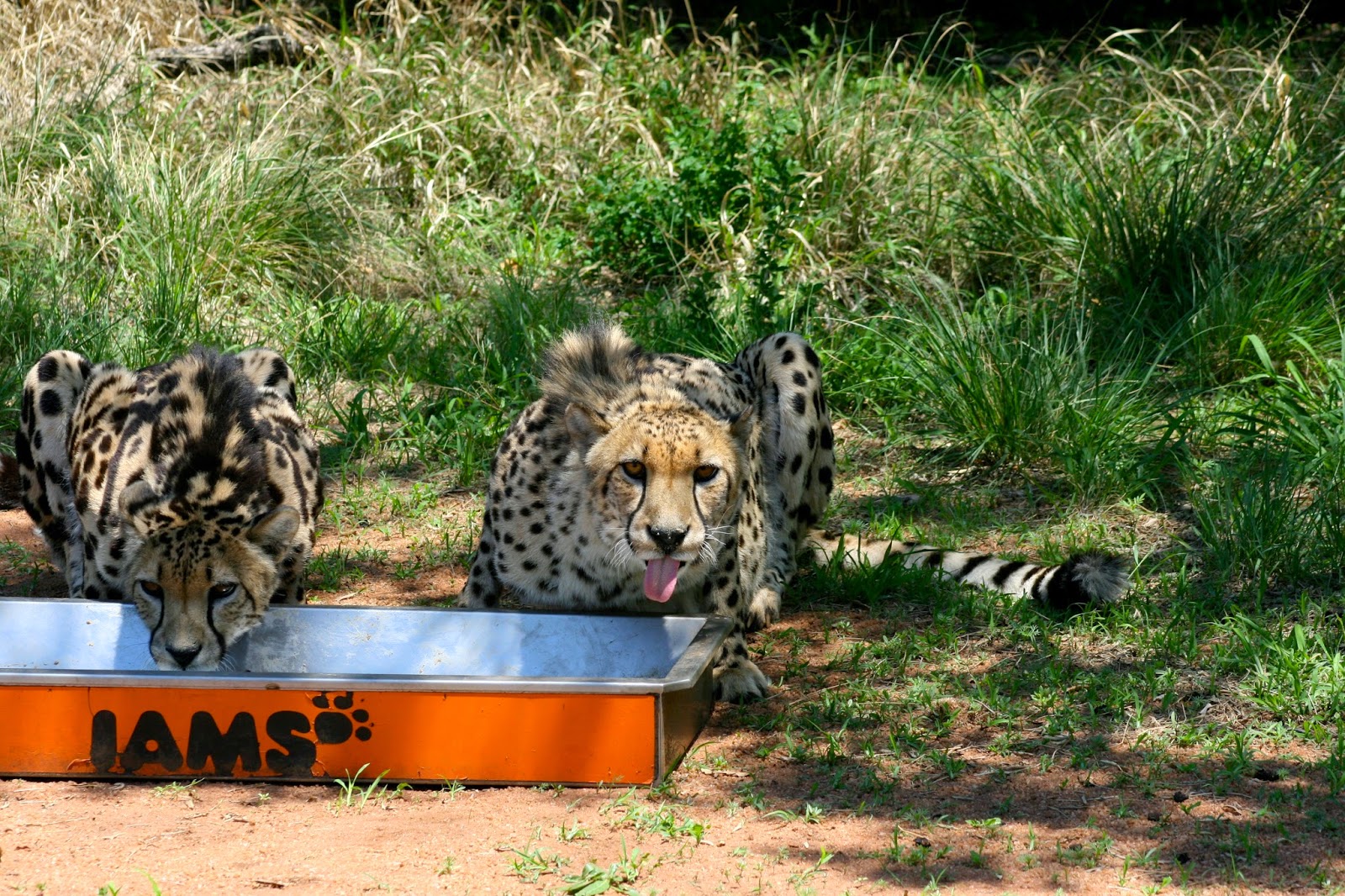
Cloning the Cheetah: Why Bother?

In an attempt to discover why the cheetah has such a low fertility rate, a team of scientists, including David Wildt and Stephen O'Brien, decided to take a look at blood samples from a number of cheetahs, labeled "Vulnerable" by the IUCN.  What they found was startling, and very worrying; the cheetahs appeared to be dangerously, perilously inbred; they were all practically clones of each other. 

Wildt and O'Brien decided to confirm this hypothesis by taking skin samples from a number of cheetahs, and attempting to graft them onto a number of other cheetahs.  In a healthy population of animals, the skin grafts would be immediately rejected.  This is because the body of the animal who received the skin graft would recognize the skin to be from another individual, a foreign body, and attack it, just as it would attack any foreign body (i.e., germs or bacteria.)  Even in humans, skin grafts are often rejected, even ones from close relatives.
Normally a very majestic looking animal, this particular cheetah seems to have been caught at a bad time.  Photo Credit: Ted and Gail Neher
So when every single one of the cheetah skin grafts were accepted by the other animals, this did not bode well for the cheetah.  This meant the genetic diversity of the cheetah was incredibly, shockingly low.  But why is genetic diversity so important?  Well, without genetic diversity, the DNA of the individuals comprising a given population are very similar.  These individuals essentially become clones of each other, with many similar attributes, most important among them their immune systems.  In a healthy population of, say, cheetahs, say that fifty percent of them are immune to a certain disease, most of them evolving from a common ancestor.  The other fifty percent of the population has absolutely no protection against said disease, and the illness ravages their population.  An unfortunate (and oversimplified) event, to be sure, but fifty percent of the individuals remain to rebuild the population to what it once was.  With the low genetic diversity seen in the cheetah, if a similar disease in the hypothetical above sweeps through Africa, it is quite likely that a much lower percent than fifty would survive.  It is also possible that this disease would so ravage the global population of cheetahs that they would simply be unable to recover from this catastrophic event.
A cheetah scratching a log at the Denver Zoo.  The cheetahs incredibly slender build can help distinguish it from other cats. 
So why is the cheetah so catastrophically inbred?  Most of the time, low genetic diversity is due to a given species having passed through a "bottleneck."  20,000 years ago, cheetahs spanned the entire globe; ranging all over Europe, Asia and Africa, two species of cheetah, or "proto-cheetahs" if you will, even roamed North America (Miracinonyx inexpectatus and M. trumani.)  When the most recent Ice Age drew to a close around 10,000 years ago, the dramatic climatic changes (and likely human influences, as well) resulted in the extinction of much of the world's mammalian megafauna. Researchers think that this mass-extinction managed to knock the cheetah's numbers down to a very small population, likely comprising a mere handful of individuals.  (In fact, I remember reading once that at one time, some people thought that a single pregnant female mother was able to survive, but I don't think that this idea is all that highly regarded anymore).  While the cheetahs were obviously able to build their population numbers and density by a significant amount than that seen 10,000 years ago, this bottleneck came with a price; genetic diversity was, and is, miniscule.

Works Cited:

Related Posts Plugin for WordPress, Blogger...