Today, with the summer weather and the lack of school, I decided to take my car over to what I like to call the "
Bird of Prey Route," a little dirt road in between Superior and
Boulder about ten minutes from my house here in
Colorado. You can usually see at least one or two different types of
raptors there, and there are a number of other awesome animals that I have spotted there, as well! Today, I saw a lot of really cool
birds, as well as some
baby prairie dogs, as you can see below!
This particular species of prairie dog is the black-tailed prairie dog (
Cynomys ludovicianus). Like the other species of prairie dog, the black-tail is a highly social little
rodent. Below you can see two pups "kissing" each other, a type of interaction that members of the same family group will employ. I think this is just to help solidify familial bonds, but I'm not sure if anybody knows for certain.
Today, the bird of prey route did not disappoint! Perched in the tree in the picture below is the
red-tailed hawk (
Buteo jamaicensis), definitely the raptor that I see most often when on the route.
I also saw a pair of
American kestrels (
Falco sparverius), the species of raptor that I see second most often. I don't usually see the kestrels so close together, however, so perhaps this was a mated pair. I did see one of them fly into a hollow in a tree, which might be where a nest is hidden away!
As I was watching the hollow in the tree where the American kestrel swooped off into, I noticed several
European starlings (
Sturnus vulgaris) flying into other hollows on the tree. Then I realized that the angle of one of the hollows was just right, and that I could actually see the adult starling feed its young! If you zoom in on the picture, you can see that the baby already looks pretty big, maybe even as big as the parent!
Black-billed magpies (
Pica hudsonia) are especially abundant in the area, and I saw several of them as well.
This magpie looks like it is molting!
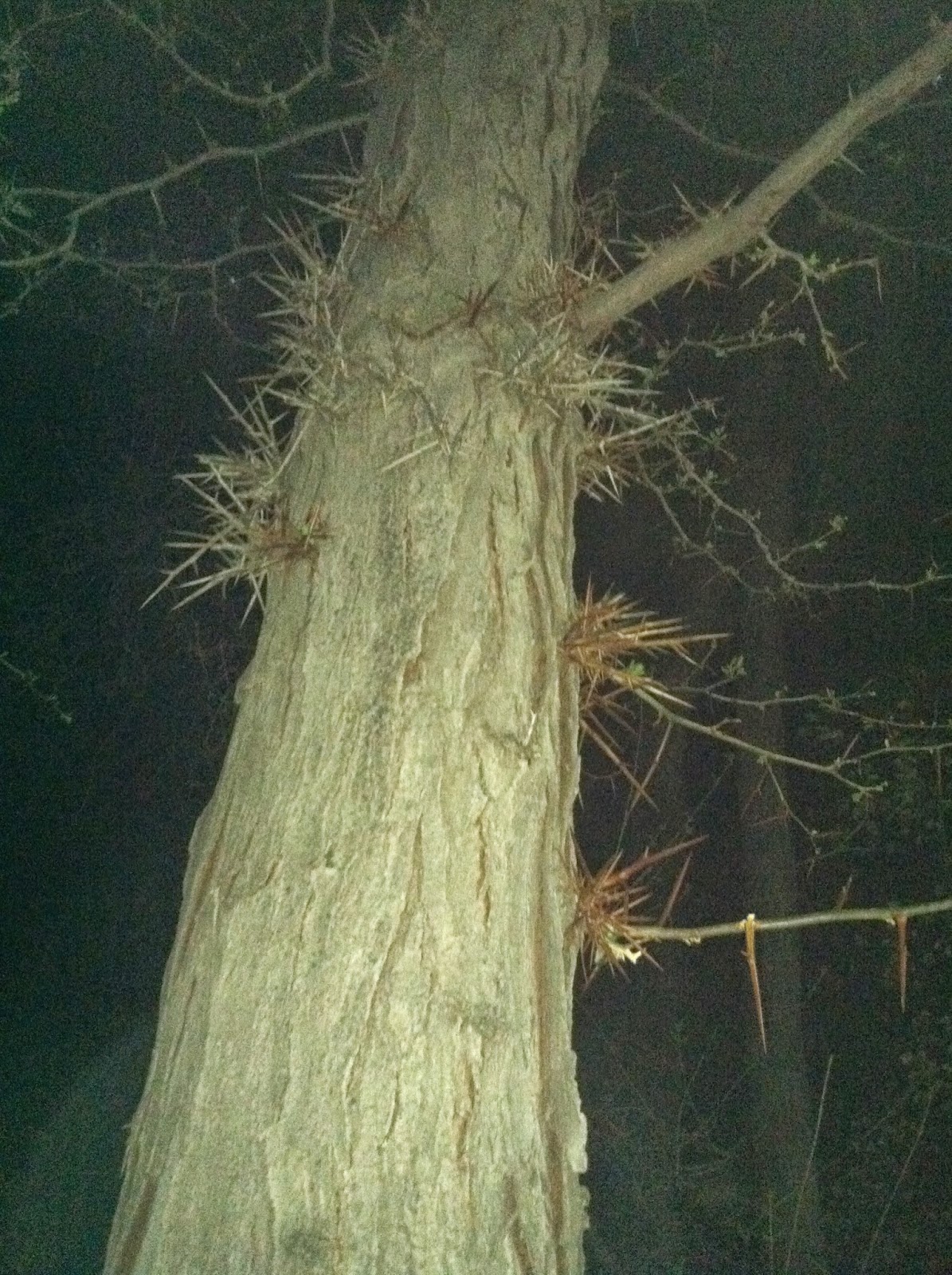
Now this particular tree presents a particularly provocative puzzle, as it is almost completely covered in some very sharp looking thorns. A few weeks ago, I saw another tree, much larger than this one, along the banks of Boulder Creek that had some enormous thorns on its branches as well, some of them easily six inches long, and super sharp on the end! I don't know for certain what kind of tree this, or the Boulder Creek tree, is, but a good candidate I think is the honey locust (
Gleditsia triacanthos), or some other tree closely related to the honey locust. Below is the picture of the tree that I took on the Bird of Prey Route.
Here is a picture of the thorns of the honey locust tree.
And here is the picture that I took on my iPhone at Boulder Creek of this tree. The thorns look pretty similar to those of the honey locust, and I think that the trunk of the tree looks pretty similar, too.
Now why do these trees have such huge thorns? That's a really good question. I started answering (or at least trying to answer) the question here in this blog post, but everything rapidly started spiraling out of control and off focus as I started talking about
giraffes, tiny
squirrels,
cheetahs, and extinct
North American elephants. For those of you who know me, it should come as no surprise that I spiraled so quickly off topic. But regardless, what I had written ended up having enough material for at least three or more posts, so I have moved the answer to a different post, which I will hopefully be publishing soon. Keep an eye out for that! In the meantime, back to the
future birds! Here, we see a pair of barn swallows (
Hirundo rustica) perched on a wire.
I'm not quite as sure about the identity of this particular bird. Also a
swallow, I am thinking that it might be a violet-green swallow (
Tachycineta thalassina).
I believe this to be a vesper sparrow (
Pooecetes gramineus).
A western kingbird (
Tyrannus verticalis), another bird that I see all the time here, at least in the summer!
At last, we have one of the most exciting birds that I saw on the route today, the blue grosbeak (Passerina caerulea), a bird that I don't remember ever seeing before!
Remember to check back soon to learn all about those massively spiky trees!
Works Cited:
Robbins, C. S., Bruun, B., & Zim, H. S. (1983). Birds of North America. New York: Golden Press.
Stokes, D. W., & Stokes, L. Q. (2010). The Stokes field guide to the birds of North America. New York: Little, Brown.