Showing posts with label Elephant. Show all posts

Monday, May 26, 2014

Thorny Trees and 20 Inch Tongues: A Case of Coevolution

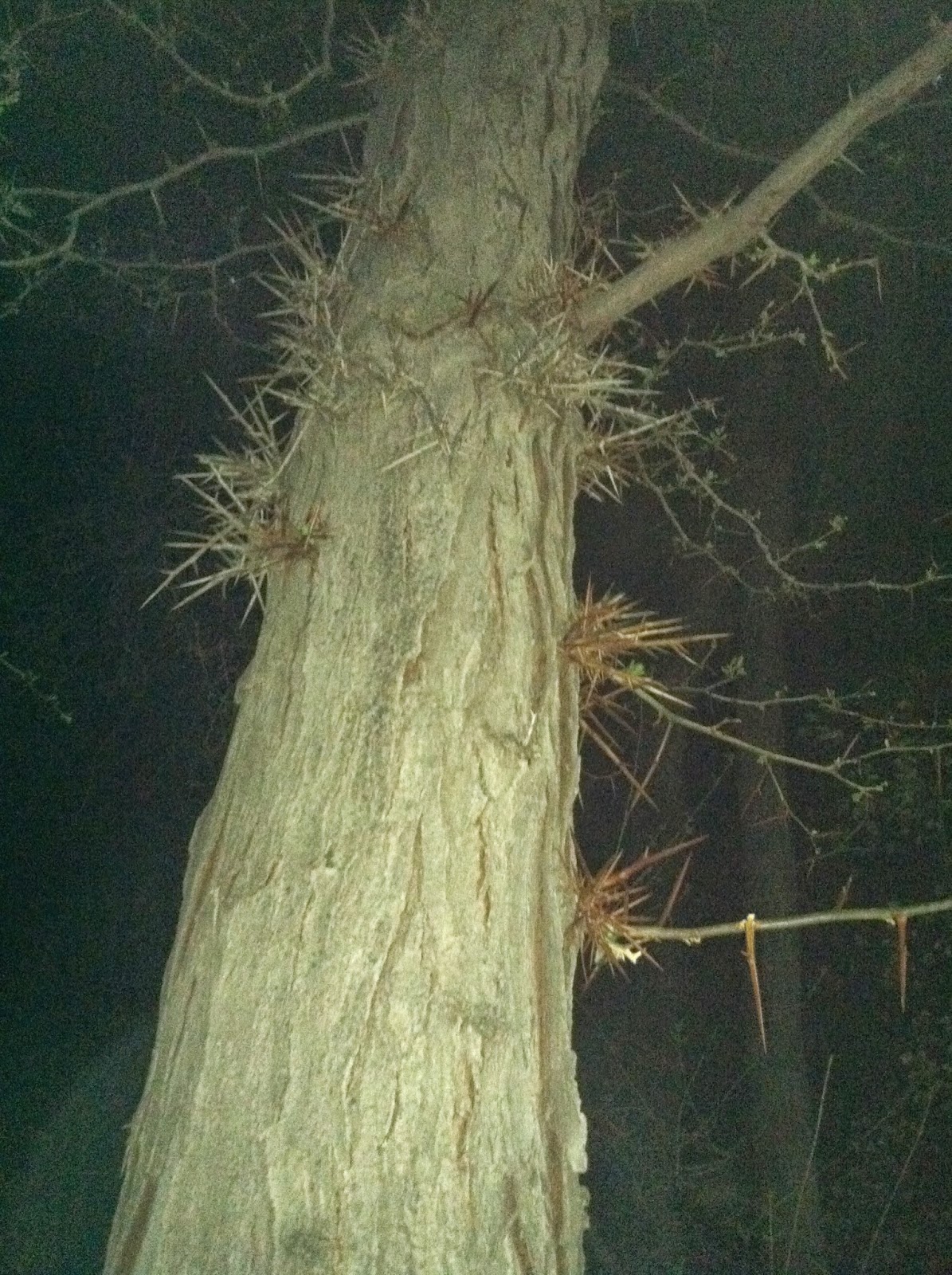
A few days ago, I saw a very spiky-looking tree on the Bird of Prey Route near my house.  A few weeks ago, I saw another tree, much larger than this one, along the banks of Boulder Creek that had some enormous thorns on its branches as well, some of them easily six inches long, and super sharp on the end!  I don't know for certain what kind of tree this, or the Boulder Creek tree, is, but a good candidate I think is the honey locust (Gleditsia triacanthos), or some other tree closely related to the honey locust.  Below is the picture of the tree that I took on the Bird of Prey Route.
And here is the picture that I took on my iPhone at Boulder Creek of this tree.  The thorns look pretty similar to those of the honey locust, and I think that the trunk of the tree looks pretty similar, too.
Now why do these trees have such huge thorns?  When it comes to nature, everything evolves with a purpose.  There is no reason why a living organism would evolve something without a purpose, especially something as involved as giant, six-inch long thorns.  The question is, what purpose do these thorns serve?  Well that's a darn good question, and I am very pleased you asked.  Much like the "thorns" that you can see on the tail of a Stegosaurus, they likely were to help keep the organism from being consumed.  We see similar thorns on the branches of some trees in the genus Acacia in Africa today.  There, the thorns help protect the tree from attacks from one of the largest plant predators alive today, the giraffe.  This tree....well, suffice it to say that you probably won't see many activists hugging this tree.

"Oh, maybe these thorns look deceptively big," you're thinking.  Wrong.  These thorns do not look deceptively big.  If anything, they look deceptively small.  These thorns are frickin' HUGE.

So the real question is, why the long thorns, Goldilocks?  Many paleontologists believe that, during the Pleistocene Epoch (which lasted from between around 2.5 MYA to about 12,000 years ago), many of North America's mega-herbivores, everything ranging from mammoths and mastodons, to giant ground sloths and the North American camel Camelops, could have been preying upon these trees.  Selective pressures slowly caused these trees to evolve protection against these mammalian mega-herbivores.  Mastodons especially had very robust teeth, which would almost certainly have made them excellent bark-munchers.

In Africa, the acacia tree, also known as the whistling thorn, the thorntree, or (my personal favorite) the wattle, has a very similar defense.  Unlike the honey locust of North America, however, the acacia tree still has to deal with intense predation today, and from a wide variety of herbivores, everything from gerenuk to giraffe, elephants to more giraffes.

You see, the giraffes love the acacia tree.  If giraffes had Facebook, then they all would like the "I <3 Acacia Trees" page.  I remember reading somewhere that they can eat up to 60 or 65 pounds of acacia leaves per day.  (To understand this, try imagining a large hunk of butter that weighs 60 or 65 pounds.  Now you have an idea of how many pounds that is.)  They love it so much that, if the acacia tree hadn't adapted to keep up with the continual browsing pressure, the giraffes might have loved the acacia trees to death!  In response, the acacia trees convergently evolved these sharp thorns, just like the honey locust tree in North America.  (We talk about convergent evolution quite a lot as it is one of my favorite topics, so click HERE to learn more about it!)  

The giraffes love the acacia, though.  They aren't going to give up on those lovely leaves, just like that!  So while these acacia trees evolved their thorns to protect their leaves, the giraffes evolved something spectacular: a prehensile tongue!  Don't believe me?  Well, one of my favorite things about the Cheyenne Mountain Zoo is that you can feed the giraffes there.  And guess what: their tongues are HUGE!  Below, I have a video of my good friend Masaki Kleinkopf also feeding the giraffes!  Check out my gangsta hoodie, yo.  
So, yeah.  Suffice it to say, giraffes have frickin' long tongues.  And they use these TWENTY INCH LONG TONGUES to help circumnavigate through the acacia tree's poky and spiny maze of thorns to reach the leaves!  The acacia tree wasn't going to just take this lying down, though: no giraffe is going to be feeding on my leaves, yo!  So the acacia tree adapted again.  This time, by employing the use of tannins.

Long story short, tannins are used by humans in a variety of ways, including tanning, food processing, and making cocoa and wine.  They also apparently taste terrible.  Don't ask me, I've never tried it, but then again I don't have a 20 inch prehensile tongue, so it's a whole different ballgame.*

Not only do tannins taste terrible, but they inhibit the digestion of the leaf matter in a number of nasty ways, none of which would be all that fun for the giraffe.  So when a giraffe starts munching on the leaves of the acacia tree, that tree will release tannins to make the leaves taste like....well, leather I suppose.  (Again, haven't tried either.)  This tannin releasing is a pretty cool adaptation all on its lonseome.  The giraffe begins to move off to another acacia tree nearby.  However, if it's within 50 yards or so (especially downwind) of the original, now tanniny acacia, then the giraffe is out of luck: the nearby acacias react in turn, releasing their own tannins, and rendering their leaves almost indigestible to the giraffes, as well!  I would imagine that, because of this, giraffes have in turn developed the behavior of moving upwind as they eat, and a cursory glance over the Internet indicates that this does seem to be a behavior observed in giraffes!  Coevolution at its finest!

Make sure to check back soon for our next episode in our coevolution series, all about a very fun little squirrel!  See you then!  In the meantime, you can read about what coevolution actually is, by clicking HERE.

*The second baseball metaphor that I believe has been used on this blog.  Refer to "23-Fact Tuesday: Prairie Falcon, Red-Tailed Hawk, and Great-Horned Owl at the Dino Hotel" and "Eye Black: What Works for Football Players Works for the Cheetah" to learn more about this sport.  

Works Cited:

Wednesday, April 2, 2014

The Lord of the Fellowship of the Island Dwarves of the Lesser Sunda Islands

We've already talked about island dwarfism several times on the blog, with examples as varied as the Zanzibar leopard, the dwarf dinosaurs of Hațeg Island, and the Channel Island fox from Catalina Island.  But now is the time for something that is several times more epic.  Today, we are going to look at the wacky, crazy, and very odd sized animals that were native to the island of Flores in Indonesia as recently as 20,000 years ago!  And oddly enough, this paleoenvironment had many similarities with the fantasy world of Middle Earth in Lord of the Rings.  Don't believe me and want to learn more?  Well that, my friends, is known as a hook, a literary device used in the opening paragraph of a work of literature to grab the readers attention.  So if you're not hooked right now, then that's because you don't like fun.  The day may come when your courage to read my blog fails....but it is not this day.  At least I hope not.
A size comparison of the brave little Hobbit, the dwarf elephant Stegodon, the Komodo dragon, and the giant stork Leptoptilos robustus, drawn by the illustrious illustrator Zach Evens!
If you aren't already familiar with island dwarfism, here's a brief summary.  Oftentimes, populations of animals will become trapped on islands.  Over deep time, they can either evolve and adapt....or die.  On islands, what was beneficial on the mainland might not be quite as useful on a smaller, isolated chunk of land.  For example, if you are a larger animal, you are going to need more food than a smaller animal.  On the mainland, where food can be found in relative abundance, this usually isn't as much of an issue.  Furthermore, being large helps ward off predators, and can increase the likelihood of passing off your genes to subsequent generations.  So for some mainland animals, it pays to be bigger.

Now slow down and grab on to something solid.  Imagine a group of elephants becomes isolated from the mainland, and trapped on an island with limited food supply and other resources.  Now all of a sudden, its the larger elephants that are dying off, starving to death.  The biggest of the bunch are unable to find enough food for their regular breakfast (not to mention second breakfast or elevenses), and unable to pass on their genes.  Suddenly, being small is looking pretty good!  Furthermore, if the island that these elephants are trapped on has geographical features that ensure mainland predators shall not pass onto the island, then the smaller elephants aren't being removed from the gene pool by predators.  If you hit the gas pedal and speed up a few thousand years or so, you might get a population of cute little pint-sized elephants.  Which, as we have talked about before, does indeed happen, and has happened numerous times throughout history.

So there's island dwarfism in a cute little nutshell.  This tiny little idea pertains to the island of Flores in a big way, as it potentially miniaturized a member of the human family tree!  Meet Homo floresiensis, nicknamed "the Hobbit" by its discoverers!  At only three and a half feet tall, this little guy would almost certainly be wasted at cross-country!  Initially announced in 2004, the discovery of at least six individuals of this cute little member of the human family tree have shown that this proto-human was not simply a genetic anomaly of this properly proportioned Pleistocene populace, but instead a participant in this posse of pint-sized people.
One small brained individual contemplates another.  The smaller skull is a cast of the skull of Homo floresiensis.  Photo Credit: Zach Evens
The evolutionary relationships of Homo floresiensis are still poorly understood, as different bits of the skeletal anatomy indicate different possible ancestors.  For example, brain shape, thick cranial bones, a short flat face, and a sloping forehead are features echoed in another early human, Homo erectus.  H. erectus does seem like a logical candidate for the ancestor of H. floresiensis, as H. erectus is thought to have inhabited southeast Asia as recently as half a million years ago.

Other scientists believe that there is more to this hobbit than meets the eye.  Not everything matches terribly well with the "Insular Dwarfing of Homo erectus as an Explanation Regarding the Small Stature of Homo Floresiensis" hypothesis.  In proportion to the rest of the body, the brain does not typically dwarf nearly as much when it comes to island dwarfism.  However, the Hobbit's brain size did seem to decrease dramatically, a phenomenon not typically seen in island dwarfs, with the possible exceptions of the Myotragus cave goat and the Malagasy hippo Hippopotamus lemerlei.  Therefore, some scientists hypothesize that H. floresiensis is not actually a dwarf at all, but was instead a "living fossil," an informal term used to describe animals whose closest relatives are all extinct.*  In this other scenario, scientists suspect that H. floresiensis shouldn't even belong to the genus Homo, and instead is a descendant of Australopithecus, another genus of ancestral human, members of which are thought to have survived as recently as two million years ago.  If H. floresiensis was instead a living fossil, then an island might be the perfect place for this brave little halfling to find refuge.

Besides dwarfism, islands can also serve as evolutionary holdout areas for animals that might not have been able to compete with other species on the mainland.  An excellent example of this is a member of the reptilian sphenodonts, lizard-like animals who can trace their evolutionary origins past that of lizards and snakes, all the way back to the Late Triassic Period, when dinosaurs were first evolving.  Today, the only place where you can find a living sphenodont, known colloquially as the tuatara, is on a number of small islands off the coast of New Zealand.  For whatever reason, this fascinating primitive reptile was unable to keep up with the rapid pace of evolution on the mainland, and found island life to be more its speed.  Unfortunately, introduced animals such as rats carry the potential to exterminate the tuatara within our lifetime.  With nowhere to go when the going gets tough, islands can be very dangerous places indeed.

Several lines of evidence support the idea of H. floresiensis actually being a descendant of Australopithecus, including morphological characteristics of the teeth and mandible, as well as the small brain size mentioned before.  A third hypothesis has been created to explain away the small size of this early human, which pertains to pathological conditions such as microcephaly, Laron Syndrome, and myxoedematous endemic hypothyroidism.  To read more about the support for and against these pathological conditions in regards to H. floresiensis, you can click HERE: this post goes ever on and on, and we still have a lot more ground to cover.  Besides, is it not strange that we should suffer so much fear and doubt over so small a being?  Such a little being.
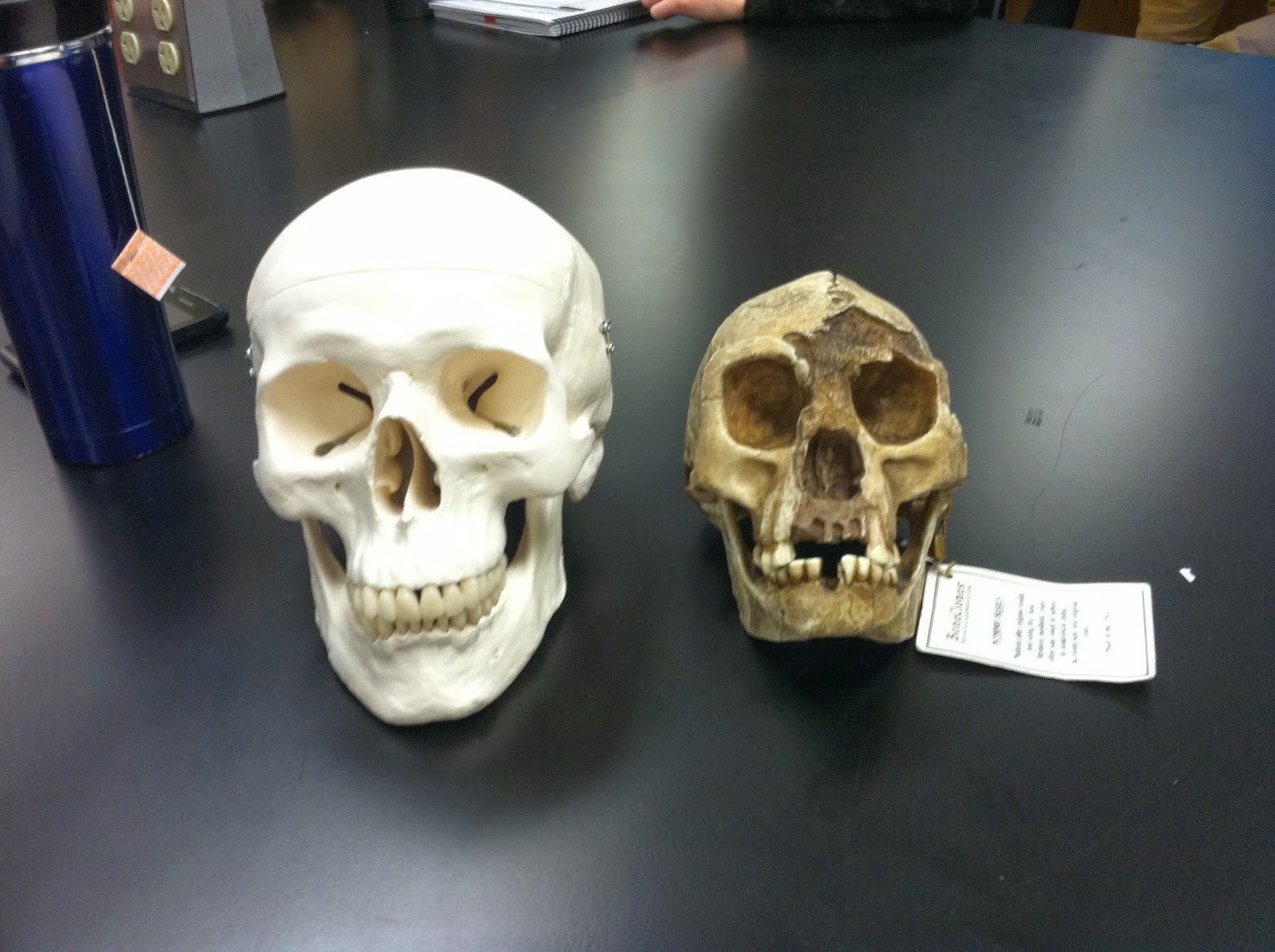
A quality pic that shows a modern human skull on the left, and the skull of the Hobbit on the right.
"Boy, it sure would be easier to cover all of this ground if we could ride on the back of some giant elephant thing," thought an innovative member of the Haradrim people one day in Middle Earth.  Fortunately for this dreamer, he wasn't the only one who shared this vision.  The oliphaunts, giant relatives of elephants, were in no short supply, and were eventually made to carry large platforms on their backs.  Boy, that sure would be convenient if one of those dwarf elephants found their way onto Flores and got themselves shrunk, wouldn't it?  Well, lo and behold, meet Stegodon!  Although its mainland relatives were some of the largest proboscideans to ever evolve, a petite little version of Stegodon was endemic to the island of Flores at the same time the Hobbit was!

You know what else would have been easier?  If Frodo had taken an eagle and flown over Mt. Doom, and dropped the Ring into the volcano.**  It would be a little TOO convenient for there to be a giant eagle that lived on the island of Flores and, unfortunately, this time you are correct.  There was, however, a gigantic relative of the modern day Marabou stork, Leptoptilos robustus, which measured in at an enormous 6 feet tall!  Since it was so large, some scientists suspect that this fool would not have been doing much flying.  Instead, this gigantic stork is thought to have stalked the Pleistocene landscape of Flores, living a primarily terrestrial lifestyle, most likely due to a lack of mammalian predators.  Kind of the opposite of island dwarfism: instead of big animals getting smaller, its small animals getting bigger!  Boy, that sure would suck if that gigantism happened to something gross like rats, wouldn't it?

So we've got hobbits.  We've got elephants.  We've even got giant birds.  Is there anything we're missing?  Sure there is: dragons.  Although there weren't any fire breathing dragons on Flores during the Pleistocene, there was a gigantic lizard that prowled the landscape!  Meet the Komodo dragon which, as luck would have it, is actually still alive today!  At ten feet long and weighing several hundred pounds, the Komodo dragon is the heaviest lizard alive today, and will take humans as prey if given the opportunity.  As a matter of fact, there has even been some speculation that the Komodo dragon evolved so large in order to hunt the dwarf Stegodon that also made their home on the island, but as far as I know this is simply speculation.

Obviously, there is still a great deal that we need to learn about this ancient ecosystem, as well as about the individual species that were a part of said ecosystem.  Preciouusssssss fossils can be very difficult to find: unlike other inanimate objects, fossils don't really care one way or another if they are found by anyone, and just kind of sit there.  With any luck, in the coming years, paleontologists might discover evidence of humongous Floresian spiders, giant wolves, or intelligent trees.  Or maybe even elves.  Whatever the future holds, you can rest assured that I will be there to report on the new findings.  You have my word.

And my bow.

And my axe.


*Here on the blog, we've talked about animals such as the coelacanth and the horseshoe crab, both of whom are often referred to as living fossils.  In this context, I'm using the term loosely, as H. floresiensis is no longer alive today.  Instead, I am referring to the fact that at the time H. floresiensis was alive, it might have been considered a living fossil.

**If that didn't ruin that movie for you, keep in mind that Indiana Jones is irrelevant to the outcome of Raiders of the Lost Ark, and that Luke and Leia are siblings and made out.


Works Cited:

Friday, May 24, 2013

The First Zoo

Where and when was the first zoo?  Of course, depending on your definition of the word "zoo," different people might have different answers to this question.  The oldest known zoological collection has been excavated at Hierakanopolis in Egypt, dating to around 3500 B.C.  So far, the remains of numerous animals have been uncovered there.  According to one source, 112 different animals have been found, including elephants, wildcats, hippos, cows, hartebeest, baboons, dogs, and an Aurochs, the subject of an Animal Spotlight awhile back!  (Click HERE to check it out!)  Since my source is a few years out of date, it is entirely possible that more discoveries have been made there since then!  Despite all of this, most scientists don't believe this is the first "zoo," at least not by modern definitions, a place where anyone can come and look at these animals.  It is thought that the site at Hierakanopolis is more of a private collection kind of thing.

Most people seem to agree that the first public zoo was created by Queen Hatshepsut, a zoo that people today would define as a zoo.  Not a lot of data (at least not that I can find) exists to tell us what sort of animals Hatshepsut kept in her zoo.  Some of the animals that we do know were imported include rhinos, cattle, giraffes, leopards, monkeys, and hounds.  Presumably, some of the other animals that we mentioned before made it into the zoo, as well.

What other animals could have made it into the zoo?  A lot of this is speculation on my part, but based on the animals of the surrounding area, here are some animals that I think likely made it into these zoos:

There are many reports of other important Ancient Egyptians possessing captive lions, and it seems like captive lions would be a pretty impressive display of one's power.  I find it very likely that both cheetahs and jungle cats were members of the zoos, as well, as cheetahs (generally fairly docile around humans, especially compared to other large African cats like lions and leopards) have been domesticated a number of times throughout history.  These domestic cheetahs were used by many people, including Akbar the Great of India (who was thought to have around 9,000 cheetahs: not to be confused with Admiral Ackbar), for hunting, both for sport and for sustenance.  Jungle cats, too are reported to have been domesticated by the Ancient Egyptians in order to hunt water birds.  Mummified remains of the jungle cat are sometimes found in ancient tombs, put there by the burial people.  (I don't actually know if they have a special name or something).  

This was the birthday post of Grace Albers! Happy birthday, Grace! If you have a birthday coming up, just email me the date at cuyvaldar123946@gmail.com with the date and your favorite animals, and I will do my best to get a post in! And if you like what you are reading, please feel free to follow us here or via Facebook!

Monday, December 10, 2012

23-Fact Tuesdays: Polar Bear Celebrations, Eccentric Artists, and Unicorn Horns!

Welcome to our third "23-Fact Tuesday" which are never on Tuesdays.  I believe that this one is actually closer to a Tuesday than we ever have been before, however, so that's got to count for something!  I'd also like to thank Mona Kamath for her help on this post!  Enjoy!

1.  Despite the fact that polar bears are generally solitary, they gather annually in places like the city of Churchill in Manitoba, Canada, where they congregate together prior to the freezing of the sea ice.  When they gather in groups like this, the group is called a "Celebration." 

2.  The eccentric and incredibly odd (though undeniably gifted) artist Salvador Dalí had a pet ocelot named Babou.  He also had a pretty righteous mustache, if I do say so myself.

3.  In 1663, the German scientist Otto von Guericke "reconstructed" the mythical unicorn using the fossilized bones of a mammoth, a woolly rhinoceros, and the horn of a narwhal.  This reconstruction managed to legitimately fool some people, including Gottfriend Wilhelm Leibniz, the famous German philosopher and mathematician, who reportedly was dubious about the existence of the unicorn prior to this "reconstruction," but was convinced by Guericke's "fossil."  

4.  From wing tip to wing tip, Hatzegopteryx measured an astonishing 46 feet!

5.  Gasosaurus, a dinosaur that was described in the year 1985, was named "Gas-Lizard" because it was discovered by a Chinese gas-mining company.

6.  In order to hover and move in any direction, the hummingbird, often nick-named "nature's helicopter" moves its wings in a figure-eight pattern, as opposed to the up-and-down motion typical of other birds.

7.  Cotylorhynchus, one of the largest pelycosaurs, is quite possibly the funniest-looking extinct animal I have ever, ever seen.  It was also discovered by my 9th grade Language Arts teacher's great great uncle, J. Willis Stovall, a famous paleontologist. 

8.  One of the elephants at the Cheyenne Mountain Zoo is named Kimba, which means "Poop" (I used the nicer term for what the word actually means there) or "Corpse" in Swahili.

9.  Speaking of poop, fossil poop is known as a "coprolite."

10.  The acrobatic margay can rotate its ankles 180 degrees, which allows it to descend tree trunks head-first and hold on to branches with either their front or back paws.

11.  The white-tailed deer is named for the white patch on its rump and tail, while the mule deer is named for the fact that its face resembles that of a mules.

12.  About a third of the extant mammalian species are rodents.

13.  Hopping, the method of locomotion preferred by the kangaroos, is actually much more efficient than walking.  Of course, this is only the case if you have evolved in that fashion.  It wouldn't just be more energy efficient if we started hopping around everywhere.  

14.  Although you often hear people mention the "saber-toothed tigers," this is actually a bit of a misnomer, due to the fact that the saber-toothed cats to which they are referring to are not actually tigers, and are simply just cats.  

15.  The sweat of the Hippopotamus, is red or pink, leading people to aptly refer to it as "blood-sweat."

16.  Despite the fact that the polar bear has white fur, the color of its skin is the complete opposite: jet-black.  Talk about Yin/Yang right there.

17.  Island dwarfism is suspected to have occurred in one of our human relatives, Homo floresiensis, who inhabited the island of Flores in Indonesia up until around 12,000 years ago.  The nick-name for this ancient human is "The Hobbit." 

18.  The word "Mona" means "monkey" in Spanish.  Sure would suck if that was your name now wouldn't it!

19.  In Hindu culture, owls are a sign of bad luck.  That double sucks if you are Hindi and terrified of birds.

20.  Speaking of owls, due to the fact that they have binocular, or stereoscopic, vision (unlike other birds of prey, who have an eye on each side of its head), they have evolved the ability to turn their heads around 270 degrees in either direction.  Must be tough for them to crack their necks.

21.  Despite the fact that the creature in the picture below looks like a raccoon, it is not: that, my friends, is the raccoon dog!

22.  The tusks of the elephants are actually greatly elongated incisor teeth.  For reference, tap your front two teeth on the top or bottom of your mouth, it doesn't matter which, they are the same.  Those are your incisor teeth, you have two on each side of your mouth, eight all together.  

23.  In the narwhal, however, the tusk is their canine teeth, which (at least in our mouths) are the teeth right next to our incisors, towards the outside of our mouths. 

Sunday, October 14, 2012

Behind The Scenes at the Cheyenne Mountain Zoo!

So, as promised, something especially exciting happened at the Cheyenne Mountain Zoo this weekend!  My grandparents, Ted and Gail Neher, were able to get my dad (Mark Neher), friend (Masaki Kleinkopf), and I behind the scenes!  We got to play with the penguins, feed the grizzly bears, and check out the new elephant barn!  I am still trying to get all of my media files together (I took a LOT of video, not to mention the pictures!) but I thought that I could give you all a taste of the action right now!

Thanks again to Kelley Parker for showing us around, that was super awesome of you!  Thanks again!

First off, the penguins!  We actually got to go INSIDE OF THE ENCLOSURE and play with the penguins!  We were able to touch them, and I even got a feather or two!  (Off of the floor, of course, I wasn't just going in there and plucking the penguins!) 
 
Here, my dad and Masaki are scattering the toys for the penguins.  This way, they are able to stimulate their minds as they hunt around looking for the toys!
 
 
One of the penguins stops to admire my snazzy shoes!
 
 
Now, here are a few videos!

First, a comedic video that I made featuring penguins and Star Wars!  Enjoy!

Star Wars Penguins!

Here are the other three penguin clips that I have uploaded thus far:

African Penguin Grabs Donut Toy From My Hand
Playing With Penguins!
African Penguin Encounter!

Our next stop was at the grizzly bear enclosure!  We got to feed them!  Not by hand, of course, as that would be incredibly dangerous.  I only have one clip up so far, but it shows exactly how it is done!

Masaki Feeding The Grizzlies!

The so-called "Yoga Bear!"


Our third, and final, stop on the behind the scenes tour was a look at the new Elephant Barn!  We were unable to go on the ground floor due to the fact that the zoo's new rhinoceros had arrived within the last few days, but we were able to go up on the overhead viewing platform and check out the elephants, and we even got a glimpse of the rhino, too!  I took a lot of video here, and, again, I will post more soon when I have my wits about me!
The exterior of the elephant barn!
What will one day be (I believe) an elephant walkway.  Either that or a human walkway!
I promise, there will be more later!  Let me get my act together, and then you will be able to see more!  A WHOLE lot more!

Wednesday, September 19, 2012

War of the Wombats

There are three different types of wombat.  There is the common wombat (Vombatus ursinus), the southern hairy-nosed (Lasiorhinus latifrons) and the northern hairy-nosed (L. krefftii).  They have been classified by the IUCN, respectively, as Least Concern, Least Concern, and Critically Endangered.  Unfortunately, all three wombats face threats that could easily result in their extermination from the wilds of the earth.  Fortunately, steps are being taken to prevent such a wombacide.

In Queensland, Australia  lies Epping Forest National Park.  In just two square miles of this park live the last ninety individuals of the northern hairy-nosed wombat.  Surrounding this puny area is a 20 kilometer long perimeter fence, erected after 10 wombats were killed by dingoes a few years ago, which, considering the severity of a ten percent population loss in such a small population, makes total sense.

Although these steps are being taken to protect the northern hairy-nosed, this species of wombat still faces several severe problems.  One such problem is the fact that 75% of these wombats are male, making a boom in their population more difficult to achieve.  Fortunately for the northerners, the southern hairy-nosed wombat has a very similar reproductive system as the northern hairy-nosed.  Scientists are therefore using female southerners as surrogate mothers for the northerners.  This method is referred to as "cross fostering," and has been used successfully when it comes to other marsupials.

The other major problem confronting the northern hairy-nosers is the fact that all of the animals are located in the same place.  In the event of a disease, wild-fire, or some other similar catastrophe, most or all of these creatures could be exterminated in the virtual blink of an eye.  Conservationists think it wise to create a second population of northerners, not too far away from the first, but far enough away to ensure that a disaster could not take out both populations with one fell swoop.  Scientists and conservationists have decided that it would be most beneficial to the northerners if they were to assist in their burrow construction.

These burrows, which can be over 100 feet long, would be time-consuming construction projects.  Not only that, but a single wombat will often use up to five different burrows, moving to a different one each day.  The first wombat doesn't just leave his or her old burrow unoccupied, however, as another wombat, probably the same one every five days or so (I would guess), temporarily moves in.  It's really less of a permanent residence, like a house, and more of a time-share condo.

But just how time and energy consuming would it be to dig such a burrow if you were a wombat?  Wombats have a problem with keeping cool.  If you ask my opinion, I suspect it has a lot to do with their body design.  As we discussed a few posts ago, animals that live in hot environments typically adapt in ways to increase their Surface Area to Volume ratio, or SA:V for short.  To learn more about why this is, click HERE.  However, fossorial, or burrowing, animals, like the wombat, aardvark, marsupial mole, and many, many others, try to keep their bodies streamlined.  Like dolphins and sharks, these animals want to be able to glide smoothly through their desired area (be it water or burrows).  Having random chunks of body, i.e. the ears of an elephant or a deer, would merely slow the animal down.  That is my theory, anyways.

To keep cool in the heat of the Australian day, wombats will take refuge in their burrows.  However, to be efficient enough when it comes to trapping moisture (as water can often be very difficult to come by in the habitat of the northerns), it has been estimated that the burrow would need to exceed fifteen feet in length.  It has also been calculated that the approximate amount of energy required for a wombat to dig a three foot long chunk of burrow is about the amount of energy that a wombat would expend running twelve miles.  That means for the comforting fifteen foot length of burrow, the wombat could instead run about sixty miles.  Clearly no small effort.

The way that the scientists actually figured all of this out was really quite interesting.  To see how long it takes for a wombat to dig a burrow, experimenters Glen Shimmin and David Taggart put one wombat into a box.  (Equipped with breathing holes, of course.  As pirates and I like to say, "A dead wombat digs no holes").  The human duo then dug a hole in the ground the same size as the box.  Placing the wombat-infested box into the ground, they then opened up one end of the container, allowing the wombat free access to the soil.  Instinctively, the wombat would begin to dig.  A half an hour later, Shimmin and Taggart ceased the wombat-excavation, and carefully measured how much dirt was displaced by the wombat, as all of the displaced dirt would conveniently be shoved (by the wombat) into the box!  Convenient, huh?  During the half hour digging session, the wombat moved more than 100 pounds of dirt!  Impressive, but the team concluded that, if conservationists were to release a group of northern hairy-nosed wombats into their new territory without pre-dug burrows, it was incredibly likely that the wombats would simply dig themselves to exhaustion, and subsequent death.  An undesirable outcome for all parties involved, it was decided to dig man-made burrows, resembling those of wombats, throughout the habitat, prior to the installation of the wombat center-piece.

What are some other problems facing wombats?  Well for starters, some of these problems, even when facing the wombats in the face, are virtually invisible to them.  Wombats, like Stegosaurus, rhinos, and myself (without my contacts), are virtually blind.  You don't need eyes if you are a fossorial (burrowing) creature; just ask the marsupial mole, the golden mole, or many other types of fossorial animals who no longer use, or even have, eyes!  However, when it comes to crossing roads, their terrible eyesight really takes its toll.  Hundreds, if not thousands, are hit by cars each year.

Other problems include starvation, drought, mange, and other people problems.  Starvation can be easily caused by the gradual squeezing out of the native grasses typically consumed by wombats by other, inedible grasses.  Drought should be self-explanatory; without water, the food dies.  Without water, there is no water.  Both are not good for wombats.  Mange, for wombats at least, is a fatal skin disease.  And as for the other people problems?  Let's just say that prairie dogs can relate.  (And now, even though I just said "Let's just say," I am going to go into more detail).  Like prairie dogs, wombats burrow.  And also like prairie dogs, the habitat of the wombat is perfect for ranchers.  So it goes like this.  Ranchers come along, and bring their cattle.  The cattle step in prairie dog/wombat holes, break their legs, and die.  The ranchers, enraged, take their rage out on the culprits: the prairie dogs or the wombats.  And as we have discussed before, wombat burrows can be quite extensive.  Furthermore, the entrance holes would have to be quite fat in order to accomodate such...robust occupants. 

As we have also previously discussed, much is being done in order to protect the wombat.  Another bit of good news is that a population boom of around 10% was recorded for the sole population of the northern hairy-nosed wombat!  Another wee bit of hope in a world that we willfully wish not to become wombatless.

WOMBAT FACTS:

  1. Cooling Off:  Besides retreating into their burrows, wombats will also flick dirt onto their bodies to keep cool.
  2. Olympic Runners:  Despite its dumpy appearance, the wombat can reach a top speed of around 25 mph.  This means that it can outrun an Olympic sprinter, like Usain Bolt!
  3. Cooling Off V 2.0:  Besides retreating into their burrows and flicking dirt onto their bodies, wombats are also nocturnal, meaning that they avoid the heat of the day.
  4. Life Span:  Wombats can live around twenty years.
  5. Wombat Wesearch:  Prior to around fifteen or so years ago, not much research had been done on wombats.  Most of what we know has been discovered since that time.
  6. Power House Excavators:  For their size, wombats may be the world's most powerful excavators.

Wednesday, August 22, 2012

The Sounds of Star Wars

The dog that was once owned by George Lucas has gone down in history in more ways than one.  One very famous example stems from the dogs name: Indiana.  This inspired the first name of the swashbuckling adventure hero "Indiana Jones" from the film franchise of the same name.  Another very important legacy of Indiana (the dog) stems more from appearance.  Apparently, the idea for Chewbacca, the lovable Wookiee from the Star Wars franchise, came to Lucas when he saw Indiana sitting up in the passenger seat of Lucas's own car!  In fact, the name "Chewbacca" apparently is derived from the Russian and Ukrainian word "собака," which means dog.

Ben Burtt, the sound editor for all six Star Wars movies, recorded a number of bear sounds for the purpose of creating Chewbacca's speech.  Along with bears, cats such as the lion and the mountain lion were also recorded.  Camels were used in addition to these fiercer companions.  These were by no means the only contributions by the animal world to the sounds of Star Wars, however!  For example, when it came to the patrons in the Mos Eisley Cantina in Episode IV: A New Hope, many different tactics were utilized.  Synthesized Latin and chopped-up Swahili served for two of the customers, but animals were used as well.  One patron's laughter stemmed from a hippopotamus, while anothers came from a spring peeper tree frog.

That's not all when it comes to the Cantina scene, however!  Ponda Baba was the Aqualish alien, below, who, along with his friend Dr. Evazan, picked a fight with Luke Skywalker and Ben Kenobi.  He was "voiced" by a walrus.  Meanwhile, besides "dogs growling and bats squeaking," the "laughter" of hyenas was also used for the laughter of some of the Cantina's other patrons. 


Here are some more sounds, and what kind of animals contributed to their creation:

Geonosians:  Here is what Matthew Wood, the actor who brought the voice of the famous and much-loved General Grievous to life, has to say regarding the sounds made by the Geonosians:

"I recorded the mating calls of penguins as they came back from the Antarctic to little Phillip Island in Melbourne.  Other sounds came from when I was up in the rain forest; I was in a flying fox area, and they let me get close to these two flying foxes.  One of them had a banana, but the other one wanted some of it, so they started fighting.  They were really mad, and I recorded that whole thing.  So, for the Geonosians, Ben [Burtt] combined mating penguins and fruit bats fighting over a banana."

The penguins that he is referring to are the korora, commonly called the little blue penguins, discussed in a recent post.  They would also not have been returning "from the Antarctic," as these birds, the smallest known penguin, past or present, are not cold-weather birds, and really stick pretty close to Australia.

Boga:  One of my absolute favorite characters (yes, I know, technically she is just an animal, but still) was voiced by a combination of one of my favorite REAL animals, the Tasmanian devil, along with a few yelps from dogs and coyotes.

Wampa scream: An elephant bellow, overlied by the squawk of a sea lion.

Mynocks:  The whinny of a horse played backwards at half the normal speed, beginning with the bark of a seal.

Ugnaughts:  The noises made by these pig-like aliens were primarily from the pups of an arctic fox, as well as the mother, but a bit of "raccoons in a bathtub" was mixed in.

Rancor Noises:  The dachshund owned by the neighbors of Ben Burtt, the Syllas, barking, growling, and hissing.

The Sando Aqua Monster:  The deep growls that this massive creature from Episode I: The Phantom Menace makes were actually from the throat of Burtt's then-three month old daughter, named Emma.  "At one point, she had a growl in her voice when she was crying.  I thought, I can use this!  So I recorded that and then lowered the pitch way down in the computer."

 Kaadu:  The snorts of the kaadu were recorded from the sounds a whale made out of its blowhole when surfacing at San Diego's Marine World.

Kaadu/Gamorrean Guard:  Both of these creatures (the grunts of the kaadu, and everything for the Gamorrean Guard) were recorded from pigs.  Unsurprising, at least for the Gamorrean, given his appearance!

Poggle the Lesser - The leader of the geonosians (that is, until Queen Karina the Great is revealed in season two of the Clone Wars) was voiced in a number of different ways, but partially through "Swahili-type vocal clicks."

Acklay:  This creatures noises and shrieks were created from reworked dolphin noises, as well as a few pig sounds.

Octuparra Droids:  The sounds from these massive droids from the Clone Wars were partially created by cows.

Gor:  Pet of the aforementioned General Grievous, Gor was voiced by a mixture of a lion and a vulture.

Gundark:  This creature, first mentioned in the original trilogy ("You look strong enough to pull the ears off a gundark," said Han Solo to Luke Skywalker after his traumatic ordeal at the hands [haha irony (because the wampa gets his hands cut off)] of the wampa) was created from a conglomerate of a horse and a shrieking parrot.

I have to say, I think one of the coolest places to visit would be Skywalker Sound, the place where all of the sound and stuff for the Star Wars movies and tons of other movies are made, organized, edited, and such.  If they gave tours, then I would totally make the trip out there!  To take a tour of Skywalker Ranch would be absolutely fantastic!

Saturday, July 21, 2012

Denver Zoo 7/20/2012

Ok, a little off topic, I know, but please, everyone reading this blog, go see the new Batman movie.  Words fail to describe it.  Now go.

OK, back on topic.  Yesterday, a couple of friends and I visited the Denver Zoo and the Denver Museum of Nature and Science.  While I had already seen their new Toyota Elephant Passage, I did get to see a couple of things that I didn't get to last time, some of them not actually at the Elephant Passage.  Although some of the pictures are not very good at all, I would still like to share a few with you.  One of the most exciting things of the day was the new Amur leopard cub that was born recently.  With only around 30 individuals remaining in the wild, the Amur leopard inhabits the Primorye region of southeastern Russia, and is labeled "Critically Endangered" by the IUCN.  unfortunately, all of my pictures of it were terrible.  I didn't get to see the clouded leopard (JUST LIKE LAST TIME.  DARN), but I did get to see the fishing cat!  Native to Pakistan, India, Nepal, Bangladesh and Sri Lanka, the fishing cat is definitely one of my favorite animals.  So here are some pictures, enjoy! 
Elephant demonstration
Asian elephant catching lemons in its mouth.
The "Endangered" fishing cat.  Unfortunately, I didn't get to see the clouded leopard again, just like last time.  Darn. 
Related Posts Plugin for WordPress, Blogger...