Showing posts with label Komodo Dragon. Show all posts

Wednesday, April 2, 2014

The Lord of the Fellowship of the Island Dwarves of the Lesser Sunda Islands

We've already talked about island dwarfism several times on the blog, with examples as varied as the Zanzibar leopard, the dwarf dinosaurs of Hațeg Island, and the Channel Island fox from Catalina Island.  But now is the time for something that is several times more epic.  Today, we are going to look at the wacky, crazy, and very odd sized animals that were native to the island of Flores in Indonesia as recently as 20,000 years ago!  And oddly enough, this paleoenvironment had many similarities with the fantasy world of Middle Earth in Lord of the Rings.  Don't believe me and want to learn more?  Well that, my friends, is known as a hook, a literary device used in the opening paragraph of a work of literature to grab the readers attention.  So if you're not hooked right now, then that's because you don't like fun.  The day may come when your courage to read my blog fails....but it is not this day.  At least I hope not.
A size comparison of the brave little Hobbit, the dwarf elephant Stegodon, the Komodo dragon, and the giant stork Leptoptilos robustus, drawn by the illustrious illustrator Zach Evens!
If you aren't already familiar with island dwarfism, here's a brief summary.  Oftentimes, populations of animals will become trapped on islands.  Over deep time, they can either evolve and adapt....or die.  On islands, what was beneficial on the mainland might not be quite as useful on a smaller, isolated chunk of land.  For example, if you are a larger animal, you are going to need more food than a smaller animal.  On the mainland, where food can be found in relative abundance, this usually isn't as much of an issue.  Furthermore, being large helps ward off predators, and can increase the likelihood of passing off your genes to subsequent generations.  So for some mainland animals, it pays to be bigger.

Now slow down and grab on to something solid.  Imagine a group of elephants becomes isolated from the mainland, and trapped on an island with limited food supply and other resources.  Now all of a sudden, its the larger elephants that are dying off, starving to death.  The biggest of the bunch are unable to find enough food for their regular breakfast (not to mention second breakfast or elevenses), and unable to pass on their genes.  Suddenly, being small is looking pretty good!  Furthermore, if the island that these elephants are trapped on has geographical features that ensure mainland predators shall not pass onto the island, then the smaller elephants aren't being removed from the gene pool by predators.  If you hit the gas pedal and speed up a few thousand years or so, you might get a population of cute little pint-sized elephants.  Which, as we have talked about before, does indeed happen, and has happened numerous times throughout history.

So there's island dwarfism in a cute little nutshell.  This tiny little idea pertains to the island of Flores in a big way, as it potentially miniaturized a member of the human family tree!  Meet Homo floresiensis, nicknamed "the Hobbit" by its discoverers!  At only three and a half feet tall, this little guy would almost certainly be wasted at cross-country!  Initially announced in 2004, the discovery of at least six individuals of this cute little member of the human family tree have shown that this proto-human was not simply a genetic anomaly of this properly proportioned Pleistocene populace, but instead a participant in this posse of pint-sized people.
One small brained individual contemplates another.  The smaller skull is a cast of the skull of Homo floresiensis.  Photo Credit: Zach Evens
The evolutionary relationships of Homo floresiensis are still poorly understood, as different bits of the skeletal anatomy indicate different possible ancestors.  For example, brain shape, thick cranial bones, a short flat face, and a sloping forehead are features echoed in another early human, Homo erectus.  H. erectus does seem like a logical candidate for the ancestor of H. floresiensis, as H. erectus is thought to have inhabited southeast Asia as recently as half a million years ago.

Other scientists believe that there is more to this hobbit than meets the eye.  Not everything matches terribly well with the "Insular Dwarfing of Homo erectus as an Explanation Regarding the Small Stature of Homo Floresiensis" hypothesis.  In proportion to the rest of the body, the brain does not typically dwarf nearly as much when it comes to island dwarfism.  However, the Hobbit's brain size did seem to decrease dramatically, a phenomenon not typically seen in island dwarfs, with the possible exceptions of the Myotragus cave goat and the Malagasy hippo Hippopotamus lemerlei.  Therefore, some scientists hypothesize that H. floresiensis is not actually a dwarf at all, but was instead a "living fossil," an informal term used to describe animals whose closest relatives are all extinct.*  In this other scenario, scientists suspect that H. floresiensis shouldn't even belong to the genus Homo, and instead is a descendant of Australopithecus, another genus of ancestral human, members of which are thought to have survived as recently as two million years ago.  If H. floresiensis was instead a living fossil, then an island might be the perfect place for this brave little halfling to find refuge.

Besides dwarfism, islands can also serve as evolutionary holdout areas for animals that might not have been able to compete with other species on the mainland.  An excellent example of this is a member of the reptilian sphenodonts, lizard-like animals who can trace their evolutionary origins past that of lizards and snakes, all the way back to the Late Triassic Period, when dinosaurs were first evolving.  Today, the only place where you can find a living sphenodont, known colloquially as the tuatara, is on a number of small islands off the coast of New Zealand.  For whatever reason, this fascinating primitive reptile was unable to keep up with the rapid pace of evolution on the mainland, and found island life to be more its speed.  Unfortunately, introduced animals such as rats carry the potential to exterminate the tuatara within our lifetime.  With nowhere to go when the going gets tough, islands can be very dangerous places indeed.

Several lines of evidence support the idea of H. floresiensis actually being a descendant of Australopithecus, including morphological characteristics of the teeth and mandible, as well as the small brain size mentioned before.  A third hypothesis has been created to explain away the small size of this early human, which pertains to pathological conditions such as microcephaly, Laron Syndrome, and myxoedematous endemic hypothyroidism.  To read more about the support for and against these pathological conditions in regards to H. floresiensis, you can click HERE: this post goes ever on and on, and we still have a lot more ground to cover.  Besides, is it not strange that we should suffer so much fear and doubt over so small a being?  Such a little being.
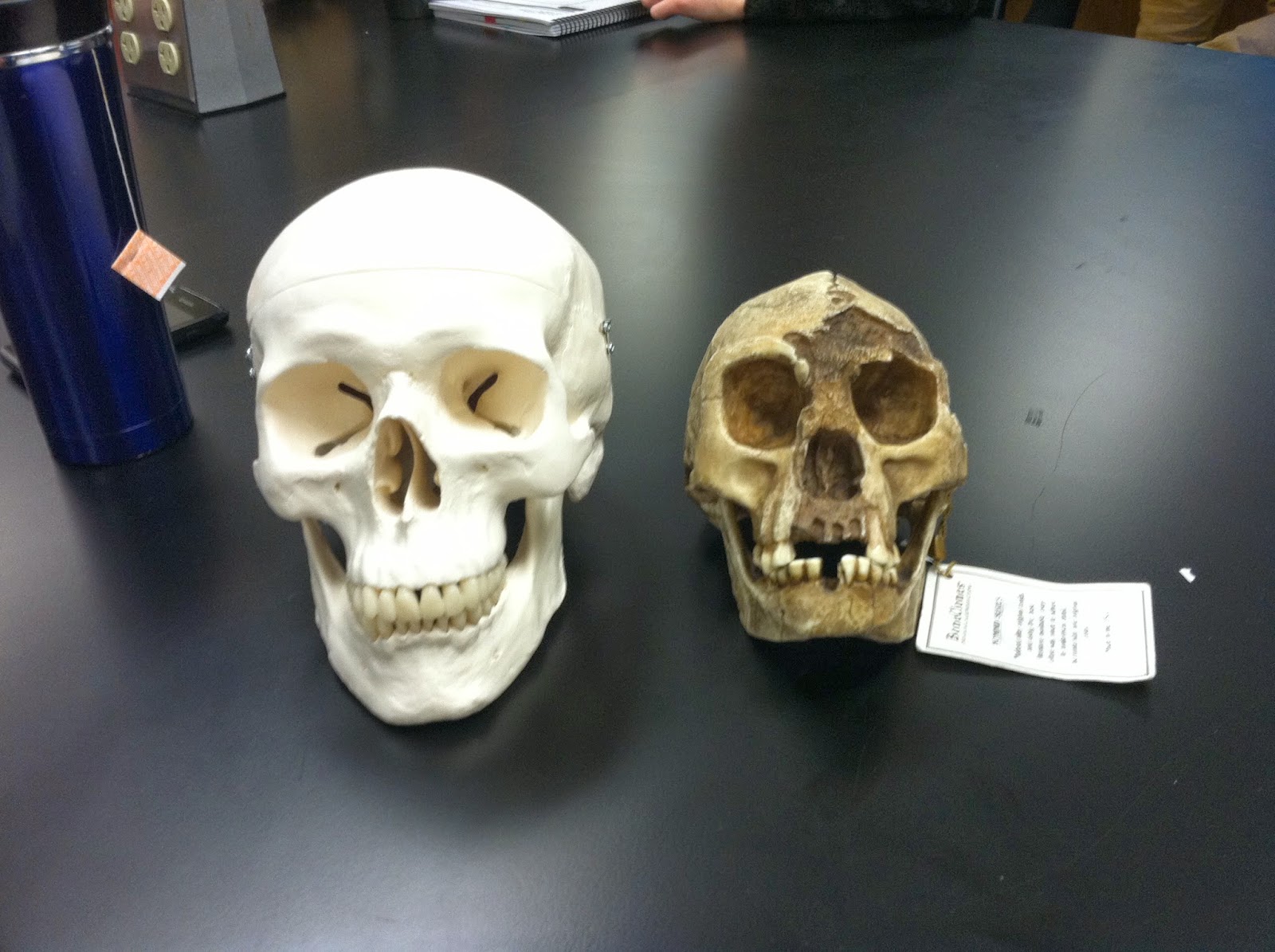
A quality pic that shows a modern human skull on the left, and the skull of the Hobbit on the right.
"Boy, it sure would be easier to cover all of this ground if we could ride on the back of some giant elephant thing," thought an innovative member of the Haradrim people one day in Middle Earth.  Fortunately for this dreamer, he wasn't the only one who shared this vision.  The oliphaunts, giant relatives of elephants, were in no short supply, and were eventually made to carry large platforms on their backs.  Boy, that sure would be convenient if one of those dwarf elephants found their way onto Flores and got themselves shrunk, wouldn't it?  Well, lo and behold, meet Stegodon!  Although its mainland relatives were some of the largest proboscideans to ever evolve, a petite little version of Stegodon was endemic to the island of Flores at the same time the Hobbit was!

You know what else would have been easier?  If Frodo had taken an eagle and flown over Mt. Doom, and dropped the Ring into the volcano.**  It would be a little TOO convenient for there to be a giant eagle that lived on the island of Flores and, unfortunately, this time you are correct.  There was, however, a gigantic relative of the modern day Marabou stork, Leptoptilos robustus, which measured in at an enormous 6 feet tall!  Since it was so large, some scientists suspect that this fool would not have been doing much flying.  Instead, this gigantic stork is thought to have stalked the Pleistocene landscape of Flores, living a primarily terrestrial lifestyle, most likely due to a lack of mammalian predators.  Kind of the opposite of island dwarfism: instead of big animals getting smaller, its small animals getting bigger!  Boy, that sure would suck if that gigantism happened to something gross like rats, wouldn't it?

So we've got hobbits.  We've got elephants.  We've even got giant birds.  Is there anything we're missing?  Sure there is: dragons.  Although there weren't any fire breathing dragons on Flores during the Pleistocene, there was a gigantic lizard that prowled the landscape!  Meet the Komodo dragon which, as luck would have it, is actually still alive today!  At ten feet long and weighing several hundred pounds, the Komodo dragon is the heaviest lizard alive today, and will take humans as prey if given the opportunity.  As a matter of fact, there has even been some speculation that the Komodo dragon evolved so large in order to hunt the dwarf Stegodon that also made their home on the island, but as far as I know this is simply speculation.

Obviously, there is still a great deal that we need to learn about this ancient ecosystem, as well as about the individual species that were a part of said ecosystem.  Preciouusssssss fossils can be very difficult to find: unlike other inanimate objects, fossils don't really care one way or another if they are found by anyone, and just kind of sit there.  With any luck, in the coming years, paleontologists might discover evidence of humongous Floresian spiders, giant wolves, or intelligent trees.  Or maybe even elves.  Whatever the future holds, you can rest assured that I will be there to report on the new findings.  You have my word.

And my bow.

And my axe.


*Here on the blog, we've talked about animals such as the coelacanth and the horseshoe crab, both of whom are often referred to as living fossils.  In this context, I'm using the term loosely, as H. floresiensis is no longer alive today.  Instead, I am referring to the fact that at the time H. floresiensis was alive, it might have been considered a living fossil.

**If that didn't ruin that movie for you, keep in mind that Indiana Jones is irrelevant to the outcome of Raiders of the Lost Ark, and that Luke and Leia are siblings and made out.


Works Cited:

Wednesday, October 2, 2013

Did Velociraptor Hunt In Packs?

Ever since the movie Jurassic Park came out in 1993, people from all over the world added the name Velociraptor to their often-short list of dinosaurs they had heard of, joining more famous dinosaurs such as Tyrannosaurus, Stegosaurus, and Triceratops. While the dinosaurs portrayed in the movie have often been hailed as “ahead of the times,” Steven Spielberg of course had to make some assumptions about dinosaur behavior.

Michael Crichton, the author of the original Jurassic Park book, did too, which can be clearly seen when reading both of his Jurassic Park books. In the first one, a theory was circulating that Tyrannosaurus had eyes like a frog, that would be unable to see something so long as it didn’t move. This is reflected in the way Dr. Alan Grant, one of the protagonists in the novel (as well as the subsequent movie) tells his comrades to react when they are spotted by a Tyrannosaurus: just don’t move. (Don’t blink. Don’t even blink. Blink and you’re dead.)  

However, this theory was debunked by the time that it came for Crichton to write his next dinosaur-themed book, The Lost World, a sequel to Jurassic Park.  In the sequel, Ian Malcolm, who was also a protagonist in the first novel, moves to the forefront. He explains that the Tyrannosaurus from the first novel was probably just not hungry enough to attack them, and that it was just toying with them. A clever way of seamlessly working that scientific transition into the books without disrupting the canon of the story!*

Spielberg also played a lot of things up throughout the movies to make it more cinematic and exciting: and, to be honest, I can’t really blame him, at least not as critically as some paleontologists do. (That, however, is a story for another time). Today, however, we are going to be talking about one cinematic Spielbergian leap, and the resounding effect it has had on paleo-enthusiasts the world over: the idea of raptors hunting in packs.

In the books and movie, the Jurassic Park raptors are portrayed as clever, cool, and calculating killing machines with the intelligence of a dolphin or an ape. Scientists know, however, that while animals such as Velociraptor and Troödon may have been smarter than their mammalian counterparts of the time, their intelligence nowhere near reaches that of some modern day cetaceans and primates. Most people don’t want to accept that, though: they want their dinos really smart!

Here’s my stab at psychology for the day. In my semester long psychology course that I took last year, we discussed something in a relationship and everyday life called a fiction. Essentially, when human beings have feelings for someone, they develop what we call “fictions” in their mind. Fictions  about physical appearance, fictions about intelligence, and fictions about other redeeming qualities as well. If two people are projecting these fictions onto each other, then a relationship can develop. On the other hand, sometimes these people are confronted with these fictions, and they realize that they are not all that they are cracked up to be. When these people fall short of their fictions, some emotional turmoil can result. In my opinion, the reality of the Velociraptor, as well as the reality of the rest of the dromaeosaurs, falls short of people’s expectations. I think a similar thing is occurring right now with dinosaurs and feathers: people want their T-rex scaly, not feathery! That might be why many people seem so opposed to the idea.

“All right,” people say. “So Velociraptor wasn’t a genius. It still hunted in packs, though, right?” It seems like a fairly obvious answer: “Of course they did! ….Right? I mean….if you think about it….” It’s when you start to really think about the evidence that this idea really falls apart. First, let’s look at a related animal called Deinonychus. Deinonychus is a mid-sized dromaeosaur, about thirteen feet long, and weighing about as much as a wolf. Living during the Early Cretaceous Period, between about 118 – 110 MYA, remains of Deinonychus have been found in the western United States. Deinonychus remains aren’t always found solo, however: in some cases, it looks like Deinonychus might have dined and died! At several different sites, Deinonychus remains have been found buried in close proximity to a large herbivorous ornithopod called Tenontosaurus.  Shed teeth from multiple animals seems to indicate that these animals might have been feeding together. Some paleontologists take this a step further, and propose that, not only did these animals feed together, but they lived and hunted together, too!

In this post, I am going to be using several modern-day analogues to point out flaws in some theories. (We’ve already done it with the deer!)  This time, we’re flying over to Indonesia to visit the Komodo dragon. The Komodo dragon is a very interesting animal that, like many other animals, will resort to cannibalism. The young Komodos take to the trees, hiding up in branches to light to support the weight of the adults.  The Komodos lead a generally solitary existence: that is, until it comes time to feed. At feeding time, the dragons will swarm all over the carcass, each fighting for a stake of the meal. To an outsider, unaware of how the animal had been killed, it might be interpreted that perhaps this was a family group that worked together to bring down a much larger prey.

Another comparison I like to make is a theoretical one. Imagine that a pride of lions has subdued a zebra on the plains of Africa. After they have eaten their fill, they move off into the shade to sleep off their recently acquired weight. Immediately afterwards, the vultures swoop in on the kill. Suddenly, somehow a flash flood overtakes the carcass and the vultures, leaving them buried in mud, sand, and silt. Over the next few thousand years, their remains fossilize. One million years later, paleontologists come across this find. To their eyes, it would appear, for all intents and purposes, like the vultures ganged up in a pack to subdue this one-toed creature. Maybe not the best comparison, but one that I always like to think about.

So does the evidence seem to allow us the conclusion that multiple Deinonychus fed together? I would say yes, the evidence does support that conclusion. Does the evidence support the conclusion that multiple Deinonychus lived together, and worked together to bring down the Tenontosaurus? In my opinion, I don’t think that that is enough evidence. Other paleontologists disagree, however, leaving the matter open for debate. Right now, what we need is a good fossil trackway.
Pyg learns about several baby Apatosaurus tracks at the Morrison Natural History Museum.  Together, these tracks create a trackway, which has revealed some very interesting behavior about these young sauropods!  To learn more, make sure to check out the museum's Facebook page HERE!
We’ve talked about trackways on the blog before. Fossil trackways are also often good evidence for group moving. We have many trackways that show groups of dinosaurs, such as sauropods, moving together in multi-age herds. We’ve talked before about the exciting conclusions that paleontologists are drawing by studying blocks of fossil footprints at the Morrison Natural History Museum. While fossil footprints aren’t always necessarily the final say, they are simply one more piece of the puzzle. And when it comes to dromaeosaur footprints, footprints that many different paleontologists agree belong to a dromaeosaur, we have none. Zilch. Zero. Nada. No dromaeosaur footprints. Not yet, anyways. So there’s one possible line of evidence down the drain.
Pyg compares her foot to the smallest baby Stegosaurus footprints in the world, also at the Morrison Natural History Museum!  These footprints us gain insights into social behavior, animal size, and locomotion.
Thus far, it doesn't seem like we have any evidence in FAVOR of Velociraptor hunting in packs. But evidence can work both ways: what about evidence AGAINST Velociraptor as a pack hunter? As a matter of fact, there is one main line of evidence that I find to be, if not conclusive, highly indicative of the truth being the pack hunting. This line of evidence comes from the environment that Velociraptor would have lived in. Velociraptor inhabited what is now the Gobi Desert of Mongolia between around 70 and 75 million years ago, during the Late Cretaceous. Back then, the Gobi looked a lot like it does today: deserty. Now, this is very important. Think about desert animals today, specifically the carnivores, but the herbivores as well. Although the desert is certainly not a lifeless place, it is by no means a party like the African Serengeti, or the great plains of North America (before the railroads came through and people killed almost all of the bison). There simply isn't enough food for large animals to get by, especially not large groups of them.

Now think about a standard predator/prey ratio seen in environments today. Let's talk about my home-state of Colorado. There are lots of places to hike in Colorado, and in almost any part of the state you can see some sort of deer, be it mule deer, white-tailed deer, elk, or moose: you name it, you can probably see at least one of these cervids at almost any place in Colorado. Now, consider this: how often do you see bears in Colorado? Or mountain lions? Not terribly often, and especially not very often when you consider how often one sees deer. That's because of the predator/prey ratio. Essentially, if the balance between predator and prey is not kept in check, then populations will crash. Therefore, it is imperative that the prey species outnumber the predator species by what is usually a significant margin, otherwise the predators will overhunt, and they will starve to death. (For a more complete discussion of the predator/prey ration, this time in the context of the lynx/hare cycle of Canada, click HERE).

Some predators can get away with hunting in groups or packs because the prey species are relatively abundant. For example, the African Serengeti. The prey density is just so incredibly high that many different types of predators, such as lions, hyenas, and African wild dogs, can all hunt in packs. It works for them, because there are just so many prey species there!

Now let us bring our attentions back to the deserts. You can walk for miles, you can drive for even more, and see hardly a sign of any vertebrate life. Most likely, all you will see is a vulture or a hawk soaring the thermals high above you, watching for its next meal. If you're lucky, you might see a deer, or possibly even a javelina (a pig-like creature native to the south western United States, as well as Central and South America). You aren't going to see a lot of them, though. And if the prey isn't plentiful, then the predators sure aren't going to be, either!

Although dinosaurian-dominated ecosystems were undoubtedly different in some aspects from the mammalian-dominated ones of today, the fundamentals of the predator/prey ration would still stand true. There just wouldn't have been enough food to go around for these animals to have been pack hunters!

So, the final question: did Velociraptor hunt in packs? Or didn't it? If I had to hazard an answer, I would say no, no they did not. Due to the extreme lack of evidence in favor of this social behavior, as well as some evidence that seems to indicate that they wouldn't have, I would say that they did not hunt in packs. Obviously, with future discoveries, my ideas may change, which is one of the great things about science: we are always learning new things! And who knows: maybe one day, it will be one of YOU who discovers that crucial bit of evidence that shows that Velociraptor did, indeed hunt in packs!

OK, that was WAY too cheesy to leave like that. I felt uncomfortable even writing it. Let's end on a joke, instead. Why couldn't T-rex clap its hands? Huh? Give up? Because he was dead. Thank you ladies and gentlemen, I will be here all week.

A special thanks to Matthew Mossbrucker and Robert Bakker for their helpful information in making this post!

*To be honest, the whole concept of the theory doesn’t make a lot of sense: think about modern-day deer as an analogue for extinct prey species. If they see a predator, they are going to freeze, as it is much more difficult to pick out a still animal from the surrounding landscape than it would be a moving animal.  So predators would have to be able to pick out the prey, otherwise it would never capture one.  This freezing behavior on the part of deer when they are startled also explains why deer often freeze in front of car headlights: deer in the headlights!

Tuesday, April 9, 2013

Island Hop (to the tune of "Thrift Shop")

Here we have the fourth song in the series, "Island Hop," to the tune of the very popular "Thrift Shop" by Macklemore.  Below is a link to the parody:


Here are the lyrics to the song:


Hey, Macklemore!  Can we go island hopping?

In-su-lar-ized...[x7]

Island, bio, geogra, phy... [x9]

[Hook:]
Australia and Tobag-
-o, Cross them both off my docket
Take a look at some of these animals close-up
Kakapo, Penguins and the Possum

[Verse 1:]
Nah, walk up to the map like, "What up with all these chunks of rock
Out in the deep blue sea, barely staying on top."
Ice in Antarctica, it's so dang frosty
That penguins like, "It's cold enough here to completely freeze a donkey."
Floatin' in, water's deep, I can see a dorsal fin,
Dressed for adventure, 'cept for one fact, I'm completely clean
Hoppin' off, walkin' round, I can really barely see
Probably should remember, there are some big animals here that need to eat-
(Hissssss)
But shoot, it's a Komodo Dragon! (Dang it)
Runnin' round, leap and bound, my death I hope to circumvent
Don't want to be a has been, someone needs to find my next of kin
But now I got a game plan
Run up to that tree and climb and
Wait up there 'til someone comes along and helps me down, really, it's a cinch
Next I'm off to Baffin Isle., turn the clock back awhile,
No for real - ask your grandpa - once the great auk here was found? (That's right)
Polar bears, arctic terns, and some things with flippers
And even more fossils if you just get diggin'
To avoid getting bored, let's head to the opposite seaboard
To the Channel Islands, much of which are rarely explored
Hello, say hello, to the Island Tree mallow,
The Channel Island fox and the introduced Catalina Island buffalo
Unfortunately, its now extinct, but at one point, there arose,
A 6-foot tall mammoth that would barely reach up to your nose

[Hook]
Australia and Tobag-
-o, Cross them both off my docket
Take a look at some of these animals close-up
Kakapo, Penguins and the Possum

[Hook]
Australia and Tobag-
-o, Cross them both off my docket
Take a look at some of these animals close-up
Kakapo, Penguins and the Possum

[Verse 2:]
What you know about island dwarfism?
What you know about the Cozumel Island fox, then?
I'm digging, I'm digging, I just can't find that page
An adult Cozumel's as big as a red one's pup
Thank your granddad for helping to slow the extinction and to-avert
'Cause right now we might still have the living thing
I'm in New Zealand, you can find me in (Wellington)
I'm not, I'm not sick of searchin' in that region (Wellington)
For the kea, the kiwi, the korora, the weka,
There ain't no native mammals in New Zealand, cept for bats, and of course whales and dolphins
Other marine ones like the seals and the sea lions
I hit the button and then through time we go flyin'
They be like, "Here we are at Hațeg - yo, let's check out the sites."
I'm like, "Whoa - that's Balaur and Hatzegopteryx."
Despite the transition, it's time to finish our mission
Magyarosaurus and Struthiosaurus - neither of which
Are very tall at all, they have both been shrimped
I call that island dwarfism at its most intenseness
That's not all that's here, though
Telmatosaurus, Bradycneme, and of course the Rhabdodon, or Rhabdodon't
But separating us from the mainland, no continental slope
In the future this place, separated from Romania it won't
Man it surely won't

(Hațeg...island dwarf...yeah!)

[Hook]
Australia and Tobag-
-o, Cross them both off my docket
Take a look at some of these animals close-up
Kakapo, Penguins and the Possum

[Bridge: x2]
Take the mainland and an island and juxtapose
It's quite incredible
They're surrounded by a moat
Which helps animals change their genetic code

[Hook]
Australia and Tobag-
-o, Cross them both off my docket
Take a look at some of these animals close-up
Kakapo, Penguins and the Possum

Is that your grandma's Balearic Islands cave goat?


Are you diggin' the songs?  Well, then check out our playlist below!

Monday, February 4, 2013

There Be Dragons

I think when it comes to reptiles, easily the most interesting are the monitor lizards and their relatives.  The monitor lizards are scientifically known as the members of the genus Varanus within the family Varanidae (which, in turn, is a family within the superfamily Varanoidea), and are widely considered to be the lizards with the most intelligence.  The largest extant (still living, opposite of extinct) lizard today, the Komodo dragon, is a member of this family, as is Megalania (often referred to as Varanus prisca), the largest known lizard ever to have existed.  Let's learn a bit more about these interesting reptiles!
According to a paper by American biologist Eric Pianka (link included in References section), the monitor lizards as a group are thought to have evolved on the continent of Laurasia (see map below) earlier than 65 million years ago (MYA), before even the dinosaurs died out.  After evolving in Laurasia, they then dispersed into the continents of Africa and Australia.  As of the writing of his paper, 44 species of monitor lizard are around today, with around 27 of these native to Australia, where the highest species density of monitor lizards are.  In the tropics of northern Australia, up to ten species of Varanus can reside together!

There are numerous families related to the monitor lizards within the superfamily Varanoidea, both living and dead, such as the earless monitor lizard, the sole member of the family Lanthanotidae.  The other extant family within the superfamily Varanoidea is the family Helodermatidae, which includes the beaded lizards and the Gila monster from southwestern North America, Mexico, and Guatemala.  However, in my opinion, it is the extinct family Mosasauridae that is the most interesting of the monitor lizard relatives.

The mosasaurs were the dominant marine predators throughout the Late Cretaceous Period, and were wiped out by the traumatic K/T Extinction Event, just like the dinosaurs.  Some of these mosasaurs could grow to enormous lengths, such as Tylosaurus, the apex predator of the Western Interior Seaway of North America during the Cretaceous Period.  Tylosaurus could grow to an enormous 50 or so feet long, and fossil discoveries of the stomach of this creature indicate that it fed on pretty much everything that swam in the sea: the remains of sharks, the flightless diving bird Hesperornis, fish, plesiosaurs, and even smaller mosasaurs have been found in the stomachs of Tylosaurus fossils!

The mosasaurs share something else in common with the monitor lizards: they both have a third eye on top of their head.  It's not the same as the eyes we have on our head, or even the eyes that the mosasaurs and monitor lizards have on their heads, either. A good comparison is if you close your eyes and look at a light source, and then move your hand back and forth in front of your face.  You can see something moving , right?  Just a shadow, but you can still tell that something is there.  That's kind of what the third eye of the monitor lizards and the mosasaurs is like.  If you are a baby Tylosaurus swimming in the sea and you see something pass overhead, you are going to swim to safety as fast as you possibly can: there are a lot of things in this sea that would barely noticed they swallowed you.  However, if you are a 50-foot long adult Tylosaurus and you see a shadow swim above your head, you are almost certainly going to go investigate.  Whatever it is, it's probably edible!

Another interesting thing that the mosasaurs most likely shared with the monitor lizards is their forked tongue, similar to that of snakes.  But what purpose does this forked tongue served?  Well, when the animal sticks the tongue out of its mouth, it is smelling the air.  As it draws the tongue back in, scent particles are pulled in as well.  The fork-tongued creature is able to determine which side of the forked-tongue has more scent particles on it.  If the animal was attempting to locate a dead animal or something like that, and its head was facing directly towards where the dead animal scent particles were floating from, the reptile would know that it was on the right track.  If, however, the fork-tonguer was facing due north, and the dead animal was due west of its position, when the tongue is drawn into the mouth, its owner can tell that there are more dead animal scent particles on the left side of the tongue, as opposed to the right, and now knows which way it must go to find its meal.  Pretty neat!

Can't get enough of the monitor lizards?  Well, below I have links to five videos featuring some monitor lizards (one spiny-tailed monitor, four Komodo dragon)!  Enjoy!

Spiny-Tailed Monitor Attempted Feeding

Komodo Dragon Moving Around at the Cheyenne Mountain Zoo

Komodo Dragon Relaxin' to the Maxin'

Up Close and Personal With The Komodo Dragon at the Cheyenney Mountain Zoo

Komodo Dragon Close Up at the Denver Zoo


And now, for some pictures of various monitor lizards I have taken over the years! First off is Herkemer, the resident Dumeril's Monitor Lizard at the Morrison Natural History Museum!
Next, we have a few photos that I took of one of the Komodo dragons at the Denver Zoo.
After that, we have a few Komodo dragon pics that I took at the Cheyenne Mountain Zoo!
Finally, we have a trio of pictures that I took of some tree monitors at the Cheyenne Mountain Zoo, as well!
And now, last but certainly not least, we have some pictures of some baby Komodo dragons at the Phoenix Zoo in Arizona!  They are pretty darn cute!
This was the birthday post of Gookhyun Jeong, happy birthday big guy!  And remember, if you have a birthday coming up, just email me the date at cuyvaldar123946@gmail.com with the date and your favorite animal, and I will do my best to get a post in! 

References:

http://www.conservation.org/FMG/Articles/Pages/gila_monsters_human_health_mexico.aspx

http://uts.cc.utexas.edu/~varanus/varanus.html

Saturday, November 3, 2012

Proterosuchus....or Should I Say "Broterosuchus?"

Before we learn about Proterosuchus, it will be helpful to discuss where this creature comes from.  Proterosuchus is an archosaur, and to understand what an archosaur is, we must first travel back 320 million years into Earth's history: back....to the middle of the Carboniferous Period.  To travel back to that period of Earth's history, click HERE TO SEE A POST I JUST MADE ABOUT THE EVOLUTION OF THE ANIMALS THAT WE ARE TALKING ABOUT RIGHT NOW.  Unless, of course, you are fine with just accepting the idea that the archosaurs are relatives of the dinosaurs, pterosaurs, and crocodilians, in which case you can just skip that post.  I think it's interesting, though, so it might be worth checking out!

Well, that was confusing.  So how does all of this evolutionary rig-a-ma-roll pertain to Proterosuchus?  Well, in his excellent book entitled "Gorgon," paleontologist Peter D. Ward actually talks about that.  Here is that passage from his book:

"During the Triassic a whole new suite of vertebrates populated the land.  The oldest true "ruling reptiles," the stock that would ultimately give rise to the dinosaurs, are found in the oldest rocks of the Triassic.  The most ancient of these is Proterosuchus.  Yet within several million years, there was a variety of these predinosaurs, belonging to a group known as the archosaurs.  From these ancestral stocks the successful lines of crocodiles and crocodile-like animals known as phytosaurs evolved.  From other members of this group came lizards, snakes, and, by the middle of the Triassic, the first true dinosaurs."  

Well, that certainly sums it up quite nicely, don't you think!  Anyways, Proterosuchus was around the size of the extant Komodo dragon, and was one of the largest reptiles alive during its time, in the Early Triassic Period.  Similar in appearance to the modern day crocodiles, it has been theorized that this animal would lie in wait much like the crocodilians, ambushing its prey when it came down to bodies of water to drink.  One bit of evidence that causes some scientists to believe that Proterosuchus hunted like the crocodilians was that the eyes of Proterosuchus were were located on top of its head, again like the crocodilians.

Remains of Proterosuchus are known from both China and South Africa, where it was first discovered by Robert Broom, a famous South African paleontologist, in 1903.  This specimen was discovered in the Karoo Basin, an enormous desert in South Africa where large numbers of fossils have been discovered. 

Wednesday, August 8, 2012

Top Ten: Extinct Sea Monsters (Part 5 of 5)

Our final edition of "Top Ten:  Extinct Sea Monsters!

9.  Tanystropheus - Living during the Middle Triassic Period, Tanystropheus is somewhat of a misfit amongst this group, as he is not really a sea-monster, and was, at most, a semi-aquatic animal (think otters).  Purportedly piscivorous, Tanystropheus fossils are usually found in semi-aquatic sites.  Its neck has been likened to that of the Plesiosaurs, like Elasmosaurus.  They would all use their necks to surprise a group of fish, long before the fish would be able to see the body of the reptile. Remains have been discovered throughout France, Germany, and Italy, amongst other places. 

10.  Tylosaurus - Interestingly enough, the closest living relative of the extinct mosasaurs, of which Tylosaurus is a member, are the monitor lizards, like the Komodo dragon.  Both the monitor lizards and the mosasaurs have a third eye on the top of their heads, although it just looks like a little white dot on the top of the head of the monitor lizard.  It doesn't work in the same fashion as their other eyes, however.  Look towards a light (not the sun, because apparently that can actually be harmful) and close your eyes.  You can still still some light, right?  Now, move your hand back and forth in front of your face, between your eyes and the light.  Can you see how the light changes?  You can't see anything more distinct than the fact that something moved between you and that light.  That is what the third eye of monitor lizards and mosasaurs would have been like.  Tylosaurus also inhabited the Western Interior Seaway during the Late Cretaceous.  Remains, amongst other places, have been discovered in Alabama and Kansas, amongst other places.

So that concludes our "Top Ten:  Extinct Sea Monsters" edition!  Unfortunate that we had to break it up into five parts, to be sure, but hey, that's life!

This post is part of the "Top Ten: Extinct Sea Monsters" series.  For the rest of the posts in this series, click HERE.  

Saturday, July 14, 2012

The Komodo Dragon: Deadly Drooler or Poisonous Predator?

The Komodo dragon (labeled "Vulnerable" by the IUCN) has long had the title of "World's Deadliest Drooler."  Native only to the Komodo Islands in Indonesia, The story went that the Komodo would bite its prey and let it slowly die, eaten away from the inside out by all of the deadly bacteria that fermented in its mouth.  It ends up that this story, as that is all it is, a story, originated from just one or two accounts of the creature almost a century or so ago, and that they were based almost entirely upon observation.  After these accounts were made public, more and more researchers and scientists tagged on to this idea until, eventually, it was a scientifically accepted fact.

Further support for this hypothesis was observations of Komodos biting buffalo, a main food source, and simply hanging around for days, weeks, and (I believe) on at least one occasion, a month.  Scientists believed that the animals would slowly succumb to the copious amounts of bacteria that were at home in the mouth of the worlds largest extant lizard

While it is true that the mouth of the Komodo dragon was, in fact, home to a number of very virulent strains of bacteria, it seems that there are other players at work.  A group of scientists noticed that the Komodo dragon, and other closely related monitor lizards, all had interesting bulges in the sides of their mouths.  These bulges they thought resembled those seen in the Gila monster, one of just two lizards that were previously known to have venom, the other being Mexico's beaded lizard.  Komodo skulls are hard to get a hold of, however, and it wasn't until 2009 that the team of researchers were finally able to get ahold of a Komodo dragon skull to put through an MRI machine.  The MRI scan showed that the Komodo did indeed have venom glands.  Although the venom appeared not to be deadly, it was potent enough to act as a sedative.  This, the team concluded, was how the Komodo would kill its victims: sedate them with its mildly potent venom, and then finish them off when they were slow and torporous. 

This didn't explain why it sometimes took weeks for Komodos to finish off a buffalo.  Kurt Schwenk believes it is because the Komodos often don't want to risk life and limb.  So what they do is they bite their victims, and let a combination of shock and bloodloss do the trick.  As the prey slowly starves, being surrounded by Komodo dragons and unable to retreat anywhere, more and more Komodos congregate in preparation of the coming feast.  And given their slow metabolic rates, they can afford to wait, too: unlike a lion or a cheetah, they are in no hurry to finish off their prey, and see no reason to take unnecessary risks to finish off the prey.

While all of this research is highly disputed, and subject to many different points of interpretation, it does seem like the idea of the Komodo killing by its toxic drool is indeed false, although only future research will decide all of this for certain.
Related Posts Plugin for WordPress, Blogger...