Showing posts with label Indonesia. Show all posts

Wednesday, April 2, 2014

The Lord of the Fellowship of the Island Dwarves of the Lesser Sunda Islands

We've already talked about island dwarfism several times on the blog, with examples as varied as the Zanzibar leopard, the dwarf dinosaurs of HaČ›eg Island, and the Channel Island fox from Catalina Island.  But now is the time for something that is several times more epic.  Today, we are going to look at the wacky, crazy, and very odd sized animals that were native to the island of Flores in Indonesia as recently as 20,000 years ago!  And oddly enough, this paleoenvironment had many similarities with the fantasy world of Middle Earth in Lord of the Rings.  Don't believe me and want to learn more?  Well that, my friends, is known as a hook, a literary device used in the opening paragraph of a work of literature to grab the readers attention.  So if you're not hooked right now, then that's because you don't like fun.  The day may come when your courage to read my blog fails....but it is not this day.  At least I hope not.
A size comparison of the brave little Hobbit, the dwarf elephant Stegodon, the Komodo dragon, and the giant stork Leptoptilos robustus, drawn by the illustrious illustrator Zach Evens!
If you aren't already familiar with island dwarfism, here's a brief summary.  Oftentimes, populations of animals will become trapped on islands.  Over deep time, they can either evolve and adapt....or die.  On islands, what was beneficial on the mainland might not be quite as useful on a smaller, isolated chunk of land.  For example, if you are a larger animal, you are going to need more food than a smaller animal.  On the mainland, where food can be found in relative abundance, this usually isn't as much of an issue.  Furthermore, being large helps ward off predators, and can increase the likelihood of passing off your genes to subsequent generations.  So for some mainland animals, it pays to be bigger.

Now slow down and grab on to something solid.  Imagine a group of elephants becomes isolated from the mainland, and trapped on an island with limited food supply and other resources.  Now all of a sudden, its the larger elephants that are dying off, starving to death.  The biggest of the bunch are unable to find enough food for their regular breakfast (not to mention second breakfast or elevenses), and unable to pass on their genes.  Suddenly, being small is looking pretty good!  Furthermore, if the island that these elephants are trapped on has geographical features that ensure mainland predators shall not pass onto the island, then the smaller elephants aren't being removed from the gene pool by predators.  If you hit the gas pedal and speed up a few thousand years or so, you might get a population of cute little pint-sized elephants.  Which, as we have talked about before, does indeed happen, and has happened numerous times throughout history.

So there's island dwarfism in a cute little nutshell.  This tiny little idea pertains to the island of Flores in a big way, as it potentially miniaturized a member of the human family tree!  Meet Homo floresiensis, nicknamed "the Hobbit" by its discoverers!  At only three and a half feet tall, this little guy would almost certainly be wasted at cross-country!  Initially announced in 2004, the discovery of at least six individuals of this cute little member of the human family tree have shown that this proto-human was not simply a genetic anomaly of this properly proportioned Pleistocene populace, but instead a participant in this posse of pint-sized people.
One small brained individual contemplates another.  The smaller skull is a cast of the skull of Homo floresiensis.  Photo Credit: Zach Evens
The evolutionary relationships of Homo floresiensis are still poorly understood, as different bits of the skeletal anatomy indicate different possible ancestors.  For example, brain shape, thick cranial bones, a short flat face, and a sloping forehead are features echoed in another early human, Homo erectus.  H. erectus does seem like a logical candidate for the ancestor of H. floresiensis, as H. erectus is thought to have inhabited southeast Asia as recently as half a million years ago.

Other scientists believe that there is more to this hobbit than meets the eye.  Not everything matches terribly well with the "Insular Dwarfing of Homo erectus as an Explanation Regarding the Small Stature of Homo Floresiensis" hypothesis.  In proportion to the rest of the body, the brain does not typically dwarf nearly as much when it comes to island dwarfism.  However, the Hobbit's brain size did seem to decrease dramatically, a phenomenon not typically seen in island dwarfs, with the possible exceptions of the Myotragus cave goat and the Malagasy hippo Hippopotamus lemerlei.  Therefore, some scientists hypothesize that H. floresiensis is not actually a dwarf at all, but was instead a "living fossil," an informal term used to describe animals whose closest relatives are all extinct.*  In this other scenario, scientists suspect that H. floresiensis shouldn't even belong to the genus Homo, and instead is a descendant of Australopithecus, another genus of ancestral human, members of which are thought to have survived as recently as two million years ago.  If H. floresiensis was instead a living fossil, then an island might be the perfect place for this brave little halfling to find refuge.

Besides dwarfism, islands can also serve as evolutionary holdout areas for animals that might not have been able to compete with other species on the mainland.  An excellent example of this is a member of the reptilian sphenodonts, lizard-like animals who can trace their evolutionary origins past that of lizards and snakes, all the way back to the Late Triassic Period, when dinosaurs were first evolving.  Today, the only place where you can find a living sphenodont, known colloquially as the tuatara, is on a number of small islands off the coast of New Zealand.  For whatever reason, this fascinating primitive reptile was unable to keep up with the rapid pace of evolution on the mainland, and found island life to be more its speed.  Unfortunately, introduced animals such as rats carry the potential to exterminate the tuatara within our lifetime.  With nowhere to go when the going gets tough, islands can be very dangerous places indeed.

Several lines of evidence support the idea of H. floresiensis actually being a descendant of Australopithecus, including morphological characteristics of the teeth and mandible, as well as the small brain size mentioned before.  A third hypothesis has been created to explain away the small size of this early human, which pertains to pathological conditions such as microcephaly, Laron Syndrome, and myxoedematous endemic hypothyroidism.  To read more about the support for and against these pathological conditions in regards to H. floresiensis, you can click HERE: this post goes ever on and on, and we still have a lot more ground to cover.  Besides, is it not strange that we should suffer so much fear and doubt over so small a being?  Such a little being.
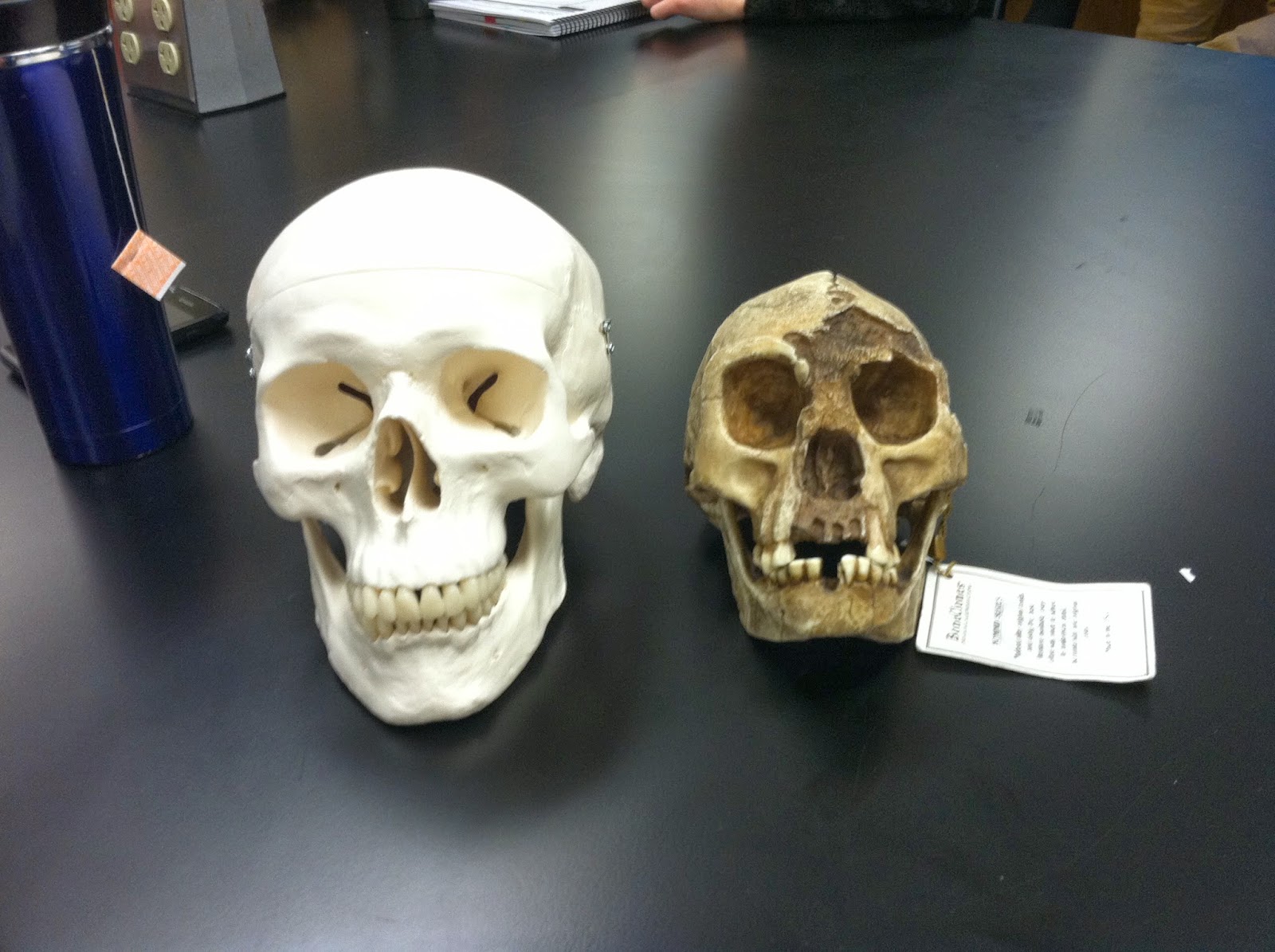
A quality pic that shows a modern human skull on the left, and the skull of the Hobbit on the right.
"Boy, it sure would be easier to cover all of this ground if we could ride on the back of some giant elephant thing," thought an innovative member of the Haradrim people one day in Middle Earth.  Fortunately for this dreamer, he wasn't the only one who shared this vision.  The oliphaunts, giant relatives of elephants, were in no short supply, and were eventually made to carry large platforms on their backs.  Boy, that sure would be convenient if one of those dwarf elephants found their way onto Flores and got themselves shrunk, wouldn't it?  Well, lo and behold, meet Stegodon!  Although its mainland relatives were some of the largest proboscideans to ever evolve, a petite little version of Stegodon was endemic to the island of Flores at the same time the Hobbit was!

You know what else would have been easier?  If Frodo had taken an eagle and flown over Mt. Doom, and dropped the Ring into the volcano.**  It would be a little TOO convenient for there to be a giant eagle that lived on the island of Flores and, unfortunately, this time you are correct.  There was, however, a gigantic relative of the modern day Marabou stork, Leptoptilos robustus, which measured in at an enormous 6 feet tall!  Since it was so large, some scientists suspect that this fool would not have been doing much flying.  Instead, this gigantic stork is thought to have stalked the Pleistocene landscape of Flores, living a primarily terrestrial lifestyle, most likely due to a lack of mammalian predators.  Kind of the opposite of island dwarfism: instead of big animals getting smaller, its small animals getting bigger!  Boy, that sure would suck if that gigantism happened to something gross like rats, wouldn't it?

So we've got hobbits.  We've got elephants.  We've even got giant birds.  Is there anything we're missing?  Sure there is: dragons.  Although there weren't any fire breathing dragons on Flores during the Pleistocene, there was a gigantic lizard that prowled the landscape!  Meet the Komodo dragon which, as luck would have it, is actually still alive today!  At ten feet long and weighing several hundred pounds, the Komodo dragon is the heaviest lizard alive today, and will take humans as prey if given the opportunity.  As a matter of fact, there has even been some speculation that the Komodo dragon evolved so large in order to hunt the dwarf Stegodon that also made their home on the island, but as far as I know this is simply speculation.

Obviously, there is still a great deal that we need to learn about this ancient ecosystem, as well as about the individual species that were a part of said ecosystem.  Preciouusssssss fossils can be very difficult to find: unlike other inanimate objects, fossils don't really care one way or another if they are found by anyone, and just kind of sit there.  With any luck, in the coming years, paleontologists might discover evidence of humongous Floresian spiders, giant wolves, or intelligent trees.  Or maybe even elves.  Whatever the future holds, you can rest assured that I will be there to report on the new findings.  You have my word.

And my bow.

And my axe.


*Here on the blog, we've talked about animals such as the coelacanth and the horseshoe crab, both of whom are often referred to as living fossils.  In this context, I'm using the term loosely, as H. floresiensis is no longer alive today.  Instead, I am referring to the fact that at the time H. floresiensis was alive, it might have been considered a living fossil.

**If that didn't ruin that movie for you, keep in mind that Indiana Jones is irrelevant to the outcome of Raiders of the Lost Ark, and that Luke and Leia are siblings and made out.


Works Cited:

Thursday, September 20, 2012

The Denver Gem and Mineral Show Part 1: Giant Ammonites, Burrowing Amphibians and Leaping Lizards

On Sunday, the 16th, my friend Masaki Kleinkopf and I visited the Denver Gem and Mineral Show at the Denver Merchandise Mart.  It was a ton of fun!  They had booths from all over the place, like the Morrison Natural History Museum and the Rocky Mountain Dinosaur Resource Center, an excellent dinosaur museum up in Woodland Park near Colorado Springs!  One of the most exciting things by far was when a pair of women came up to us, and asked if they could film us just going about our business.  They were part of a group making a movie under the working title "Quarry."  It's apparently going to be about American Paleontology, and it looks like Masaki and I may have made the part about why Americans love paleontology, and especially dinosaurs, so much!

MESSAGE FROM ZACK FROM THE FUTURE:  Hello, everyone.  This is Zack Neher.  I have travelled to this post from the future.  I wanted to give you a link to the Homebase for these posts.  I am like Rose Tyler, leaving clues in the form of Bad Wolf.  Except this is not quite like that at all really.  Anyways.  The Homebase for the series is HERE.
Creeper shot of the film crew following us, with a large iridescent ammonite in the foreground.  Notice the distinct chambers.  How magnificent.

We also saw Dr. Robert Bakker there.  After I said hello, he waved me over and said "You're a smart kid.  Can you tell me where the nostrils are on this thing?"  The "thing" that he was referring to was a baby Eryops skeleton that he has been working on, a Permian amphibian that lived in the south eastern United States.  Remains have been discovered in both Texas and New Mexico, and it was a contemporary of Dimetrodon, who most likely preyed upon it.  Upon my examination, I promptly tried to prove his assessment of my intelligence wrong, as I pointed all over the skull in my attempts to locate the nostrils.  Turns out, the nostrils were right where they should be.  They were just confusing because in life, the animal would have been able to cover the nostrils with little flaps of bone, sealing off the nostrils from dirt and such while it was burrowing.  Pretty interesting stuff!
Dr. Bakker's baby Eryops.  The snout is facing the pen in the left of the image, and the two holes that you can see are the orbitals, or the eye sockets.  The googly eyes are explained below.
Another picture from a few weeks ago.  This was taken at the Morrison Museum when my friend Kristie Chua came up to visit.  Dr. Bakker, when asked "Why the googly eyes?"  replied "I put the googly eyes on because I like it." 

We also saw a number of giant ammonites.  Below are a few pictures of the better ones, probably the largest I have ever seen!  The only other possible contender that I can think of was one that I saw at the Heritage Museum of the Texas Hill Country in (you guessed it!) Texas.  That one was a huge, probably five or six feet wide, imprint of an ammonite, right outside the entrance to the museum.  This was the same place that I have talked about before, in my Acrocanthosaurus on the Prowl post.  Great place!  I definitely recommend checking it out if you are ever in the Canyon Lake/San Antonio area of Texas!
The Heritage Museum ammonite.  Perhaps my memory is a bit off.  But I still remember it being incredibly, enormously large.  Perhaps the picture makes it looks smaller?  A mystery.  I suppose I will have to check it next time we go back there now won't I.
The ammonites, in order of amazingness.  Probably about a two, two and a half foot diameter.
Although its size was less impressive, perhaps only a foot or two wide at the most, it was most amazingly iridescent.  There were a large number of them here, but somehow I succeeded in capturing zero great pictures.  Go figure. 
Same story as above.  Not as impressive in size, but amazing in preservation quality.  Check out those septum!
Masaki next to one big ass ammonite! 
And Masaki with another big ass one!  This one a bigger ass!  Bigger ass one?  Bigger one.  A bigger one.
The third really cool thing that we saw there (that I am going to include in this post, at least) were these preserved lizards.  These lizards are from the genus Draco, and are found exclusively in Indonesia.  These lizards are remarkable as they can glide from tree to tree.  Many paleontologists and biologists speculate that this is what the earliest Pterosaurs would have looked like.  For those of you who don't know, Pterosaurs are the flying reptiles that were contemporaneous with the dinosaurs.  Often confused with the dinosaurs themselves, the Pterosaurs were distinct in that they were truly flying reptiles, and not a distinct grouping.  Calling Pterosaurs dinosaurs would be akin to calling a tiger salamander a mammal, on the sole observation that the tiger salamander is a contemporary of a squirrel.  Not so.
One specimen of the Draco lizards....
....and another!
Famous examples of Pterosaurs include (or "Pterosaurs That I Have Heard Of):

  1. Anurognathus
  2. Darwinopterus
  3. Dimorphodon
  4. Dsungaripterus
  5. Eopteranodon
  6. Eudimorphodon
  7. Hatzegopteryx
  8. Ornithocheirus
  9. Peteinosaurus
  10. Pteranodon
  11. Pterodactylus
  12. Pterodaustro
  13. Quetzalcoatlus
  14. Rhamphorhynchus
  15. Sordes
  16. Tapejara
  17. Tropeognathus
You probably also know the Pterosaurs as the "Pterodactyls."  Probably should have prefaced with that.
A skull of Darwinopterus from the show.  This guy was at the booth for the Rocky Mountain Dinosaur Resource Center, or RMDRC for short, an awesome museum up in Woodland Park.  
The wing of a good sized Pterosaur.  You can see at the bottom of the picture a white round thingy.  That's the ammonite featured in the picture with Masaki, above.  That should help give you an idea of the scale of the wing.  Probably around ten feet or so.  And get this; that whole thing is one enormously elongated pinky!
A fossil pterosaur from the show
Another fossil pterosaur from the show
Anyways, in the Imax production "Flying Monsters" with David Attenborough (FAVORITE.  IMAX.  EVER.), they talk about how many scientists speculate that these lizards of the genus Draco greatly resemble the earliest ancestors of the Pterosaurs.  Initially gliding from tree to tree to snatch flying insects in the air, eventually these small lizards would have become capable of powered flight.  Then, they would have grown larger and larger, until they became the biggest animals to ever take to the skies.  Except for humans, but really.  We don't really count.

Saturday, July 14, 2012

The Komodo Dragon: Deadly Drooler or Poisonous Predator?

The Komodo dragon (labeled "Vulnerable" by the IUCN) has long had the title of "World's Deadliest Drooler."  Native only to the Komodo Islands in Indonesia, The story went that the Komodo would bite its prey and let it slowly die, eaten away from the inside out by all of the deadly bacteria that fermented in its mouth.  It ends up that this story, as that is all it is, a story, originated from just one or two accounts of the creature almost a century or so ago, and that they were based almost entirely upon observation.  After these accounts were made public, more and more researchers and scientists tagged on to this idea until, eventually, it was a scientifically accepted fact.

Further support for this hypothesis was observations of Komodos biting buffalo, a main food source, and simply hanging around for days, weeks, and (I believe) on at least one occasion, a month.  Scientists believed that the animals would slowly succumb to the copious amounts of bacteria that were at home in the mouth of the worlds largest extant lizard. 

While it is true that the mouth of the Komodo dragon was, in fact, home to a number of very virulent strains of bacteria, it seems that there are other players at work.  A group of scientists noticed that the Komodo dragon, and other closely related monitor lizards, all had interesting bulges in the sides of their mouths.  These bulges they thought resembled those seen in the Gila monster, one of just two lizards that were previously known to have venom, the other being Mexico's beaded lizard.  Komodo skulls are hard to get a hold of, however, and it wasn't until 2009 that the team of researchers were finally able to get ahold of a Komodo dragon skull to put through an MRI machine.  The MRI scan showed that the Komodo did indeed have venom glands.  Although the venom appeared not to be deadly, it was potent enough to act as a sedative.  This, the team concluded, was how the Komodo would kill its victims: sedate them with its mildly potent venom, and then finish them off when they were slow and torporous. 

This didn't explain why it sometimes took weeks for Komodos to finish off a buffalo.  Kurt Schwenk believes it is because the Komodos often don't want to risk life and limb.  So what they do is they bite their victims, and let a combination of shock and bloodloss do the trick.  As the prey slowly starves, being surrounded by Komodo dragons and unable to retreat anywhere, more and more Komodos congregate in preparation of the coming feast.  And given their slow metabolic rates, they can afford to wait, too: unlike a lion or a cheetah, they are in no hurry to finish off their prey, and see no reason to take unnecessary risks to finish off the prey.

While all of this research is highly disputed, and subject to many different points of interpretation, it does seem like the idea of the Komodo killing by its toxic drool is indeed false, although only future research will decide all of this for certain.

Saturday, June 30, 2012

Another Living Fossil: The Coelacanth

400 millions years ago (MYA), during the Devonian Period, life had already gained a foothold on land.  However, in the seas, unless you were at the top of the food chain, there were a lot of predators to contend with.  If you were a fish in the middle of the food chain during the Devonian, you not only had to deal with ancestors of the modern day shark, but a now-extinct group of armor-plated fish, called the Placoderms.  Some of these Placoderms, like Dunkleosteus, grew to simply enormous proportions, around 30 feet in length!  One type of fish that lived during the Devonian and was most likely preyed upon by the sharks and the Placoderms was a fish known as the Coelacanth.

The Coelacanth (SEE-lah-canth) was a relatively unassuming fish, its closest living relative being the lobe-finned fish.  Fossils of the Coelacanth have been discovered ranging from 400 MYA to around 65 MYA, coinciding with the death of the dinosaurs.  In 1938, however, when one was hauled in on a fishing net off the coast of South Africa, the temporal range of this animal was extended by 65 million years!  Today, by studying the living Coelacanth, scientists have found that the fish gives birth to live young, unlike other fish.  Further discoveries both in Africa (off the coasts of Mozambique, Madagascar, Kenya and Tanzania) as well as Asia, around Sulawesi, Indonesia, of living Coelacanth specimens have further widened the current geographical range of the Coelacanth.
A specimen of the Cretaceous coelacanth Coccoderma nudum from Germany.  On display at the Mace Brown Museum of Natural History on the campus of the College of Charleston in South Carolina.
Unfortunately for this living fossil, it is labeled "Critically Endangered" by the IUCN, much like yesterday's living fossil, the mountain pygmy possum.  Just like the mountain pygmy possum, conservationist groups are working towards it's protection, trying to keep fisherman from fishing in the Coelacanth's habitat.  Hopefully, humans won't be the final nail in the coffin, so to speak, for this 400 million year old fish.
Related Posts Plugin for WordPress, Blogger...