Showing posts with label Ice Age. Show all posts

Sunday, January 5, 2014

Kicking It In Crested Butte and a Little Geology Lesson

Over the summer, my family and I took a driving trip to several sites in Colorado that we hadn't been to before, or at least not in awhile.  I never got around to sharing pictures from that trip, but now that I have some free time on my hands, I've decided to go back and share some of the cooler pictures from that trip!  Let's start in the awesome and beautiful Crested Butte!
First off, a little geology lesson!  According to some of the signs placed along the path near town, Crested Butte* is something called a laccolith.  As you can see on the diagrams below on the sign, laccoliths look kind of like pimples that form at some places on the earth's surface.  First, layers of sedimentary rock were deposited.  Next, igneous rock in the form of magma melted its way through several of the underlying sedimentary layers, as you can see in the second picture.  The presence of more matter caused the overlying sedimentary layers to be pushed up, while the underlying layers remained flat.  
Over time, the magma cooled and crystallized, forming a granite-like igneous rock, with crystals of feldspar mixed in.  By using radiometric dating, geologists have determined that these rocks were formed around 30 million years ago, during the Oligocene Epoch.  Over those last 30 MY, erosion and weathering have broken down those layers of sedimentary rock that once covered the laccolith, and exposed the intrusion.  The intrusion is what makes up what you would walk on and see when you are on the mountain. 
A picture of some of the rocks near the summit of Crested Butte.  You can see a little pika peeking out from behind a rock in the center of the picture!  Interestingly (at least to me), the last time I talked about either pikas or the Oligocene Epoch was in the same post, the "Top Ten Mammals That Look Like Something They Aren't (Part 1)," a fun post if there ever was one!
Crested Butte (the mountain) has been further isolated from the surrounding mountains due to the influence of glacial forces.  Telltale signs of past glaciation are abundant in and around Crested Butte, including the u-shaped valleys, polished bedrock, giant boulders in places where they have no business being, and moraines (defined below), amongst other lines of evidence, all point to past episodes of glaciation.  Geologists have dated most of the moraines as about 22.5 to 16.5 thousand years old, during the last Ice Age, and believe that glacial retreat occurred rapidly about 15,000 years ago.  Even older glacial deposits date back to around 100,000 years ago!  

The scenery was truly spectacular between the town and where we were staying, up near the mountain resort, which in turn was next to the very confusing home rule principality of Mt. Crested Butte.  At times, the path turned into a boardwalk, which helped to preserve the wetlands in the area.  
Towards town, we passed over the Slate River.
A shot of the bridge over the Slate River in the foreground, with Crested Butte in the background.
As you can imagine, the area was populated by numerous birds, several of which I got pictures of.  I am fairly confident that this first one was a female mountain bluebird (Sialia currucoides).
We also saw a ton of killdeer (Charadrius vociferus), a fascinating bird, the adults of which will feign injury to draw predators away from fledlings, nests, eggs, and the like.  I've included a video which shows one of these animals doing its injury feigning!  In case the internal link or whatever it's called isn't working, click HERE to view the video.
Here are the pictures I took of the many killdeer running around!
A few more shots of the amazing scenery!
The next day out the window of the hotel room, we saw a pudgy dog walking by with a neck pillow looking thing around its neck.  A little research revealed that this was a KONG Cloud E-Collar, which pretty much serves the same purpose as the cone that you put on dogs and cats after surgeries or the like.  
Here is another picture of the dog.  This time it is relieving itself.
We ate breakfast at a fun little place along the creek!  I had a pancake that was ridiculously enormous.

There were lots of very pretty flowers all over town, including these yellow or wood poppies (Stylophorum diphyllum).  
I don't remember which building it was exactly, but one of the buildings in town had the mounted head of what is supposedly the world's largest rack of elk antlers, shot in Crested Butte in 1899 by a man named John Plute.  The antlers were certified as the largest in the world in 1961.  They definitely did look pretty large!

We'll be looking at more pictures from Crested Butte later!  See you then!


*Point of interest and possible confusion: Crested Butte can refer both to the town with a population of around 1,000, or the mountain with an elevation of 12,168 feet.  If you hear someone talk about Mt. Crested Butte, then they are most likely referring to the home rule principality by that name.  I don't really know what a home rule principality is, and a little bit of research nearly put me into a deep, trance-like state.  

Works Cited:

Wednesday, June 19, 2013

The Zanzibar Leopard: A Lesson in Island Dwarfism....and Extinction

Very few people have heard of the Zanzibar leopard, unless of course you are a person from Zanzibar, an island ecologist interested in insular leopard populations, or you are another Zanzibar leopard.  (Which might be problematic, being another Zanzibar leopard, but we'll get to that later.)  In the meantime, let's look at what makes the Zanzibar leopard so special: its size.

When a population of animals becomes trapped on an island, they have to adapt or die: it's just that simple.  While many populations simply succumb to death, other populations of animals can sometimes shrink over the course of many generations, eventually becoming dwarfs of their former selves.  It's called island dwarfism, and it's happened many, many times throughout the history of life: the dwarf dinosaurs of HaČ›eg; the Channel Islands pygmy mammoth and the Channel Islands fox; the Cozumel Island fox and the Cozumel Island raccoon; and many, many others.  The subject of today's post is (you guessed it!) the Zanzibar leopard and, as you also might have already guessed, this particular leopard is an island dwarf!  

The leopard (Panthera pardus) is simply a fascinating animal.  Able to drag prey weighing more than three times its own weight in some cases, this mid-sized feline is the midnight stalker of the African savannah.  An occasional man-eater, there are numerous sub-species of the leopard, although no one can quite agree just how many there actually are.  While some people claim that there are just a few sub-species, others have claimed that there are around thirty!  However, most scientists agree that, at least for now, there are only eight or nine sub-species.  For regular readers of the blog, you've actually met a few of these sub-species already!  Probably the most famous, the African leopard (P. pardus pardus), was featured in a post about a year ago, entitled "Predators of Baby Leopards: You Might Be Surprised," in which we talked about....well, just read the post for yourself!  More recently, we met the Amur leopard (P. p. orientalis) in a post entitled "An Amur Leopard Upchucks."  I'm pretty sure you can figure out what that post is about all on your own.

There is some debate about whether the Zanzibar leopard is simply a separate population of the African leopard (P. p. pardus), or whether it is a distinct population defined by genetics.  When it is defined as a separate sub-species, the Zanzibar leopard has the scientific name of Panthera pardus adersi.  We'll talk more about this genetic confusion later: but that's enough about the genetics,  let's get to the interesting stuff!

Scientists think that the Zanzibar leopard has been isolated from the rest of the African leopard population on the mainland since the end of the last Ice Age, at which point global sea levels would have risen, cutting off the two main islands of the Zanzibar Archipelago, Unguja and Pemba, from the mainland.  Unguja, which is informally known as Zanzibar, is where the Zanzibar leopard can be found: at least, it used to be found there.

Remember when we were talking about how scientists can't really agree on whether the Zanzibar leopard is a distinct sub-species or not?  Well, their research is not aided by the fact that the Zanzibar leopard seems to be extinct.  Following the Zanzibar revolution in 1964, the government began a program to eradicate the Zanzibar leopard, both to stop apparent live-stock killings attributed to the cat, as well as to eliminate the leopard as an apparent source of witchcraft.  Research conducted in 1996 indicated that the leopard still survived on the island, but more recent research in 2002 has found no sign of the leopard.

Adapt or die: that's the mantra of the island animal.  When you throw humans into the mix, unfortunately its the second option that seems to occur most often.  Thousands of island animals have been exterminated by humans as their habitat is destroyed in the name of progress.  With nowhere else to go, they die out, leaving behind a legacy of destruction.

This was the birthday post of Ted Neher! Happy birthday, Grandpa! If you have a birthday coming up, just email me the date at cuyvaldar123946@gmail.com with the date and your favorite animals, and I will do my best to get a post in! And if you like what you are reading, please feel free to follow us here or via Facebook!

Monday, December 31, 2012

The Ancestral Australian Aborigines As a Possible Cause for the Extinction of Australia's Pleistocene Marsupial Megafauna

A few weeks ago, in my Anthropology class, we had to do a cultural profile of one culture group of humans.  I chose the Australian Aborigines and, having just finished Tim Flannery's excellent book "Chasing Kangaroos," this whole concept of the Ancestral Aborigines being the possible cause of the extinction of Australia's Pleistocene megafauna was still quite fresh in my mind, so I included it in the paper.  I thought it was pretty interesting, and so I have decided to share it with ya'll, too, with a few brief modifications to make it more Blog friendly!  Hope you enjoy, and if you want a more comprehensive look at the topic, I highly recommend "Chasing Kangaroos!"

Interestingly, paleontologists today are using the Australian Aborigines to help them figure out when Australia's Pleistocene megafauna went extinct.  While today, there are no native animals larger than the red kangaroo, Pleistocene Australia was a very different place, as was the rest of the world.  The Pleistocene Epoch was the time of the Ice Age megafauna.  With the exception of Africa and south-east Asia, in most places nowadays, the Pleistocene megafauna is extinct, but back then, the megafauna were a world-wide phenomenon.  In Eurasia, there were the giant mammoths and rhinoceroses, the cave lions and hyenas, the Irish elk, and the giant polar bear.  In North America, there were the mammoths and mastodons, the short-faced bear, the giant bison, the dire wolf, the giant beavers, and the saber-toothed cats.  In South America, there were the giant ground sloths, the armored glyptodonts, and many large relatives of elephants.  

Australia also had its fair share of Pleistocene megafauna, with marsupial lions, the giant short-faced kangaroos, the hippo-sized wombat Diprotodon, and echidnas that were the size of sheep.  There are two main hypothesis when it comes to what caused the extinction of all these animals: climate change, or hunting by early human arrivals on Australia, the first Aborigines.  No one could figure out whether it really was the Aborigines that had hunted the megafauna to extinction, though, because no one could figure out the date that the megafauna had gone extinct, nor could they figure out the date that humans first arrived on Australia.  Some people believed that the megafauna survived until around 6,000 years ago, while others believed that they went extinct a great many years prior.  The same difficulties confronted those scientists attempting to determine when humans first arrived.  The sediments of Australia are notoriously hard to date, and since the animals of Australia are so unique (especially following the extinction of the dinosaurs), scientists were unable to correlate their data with other places around the world.[1] 

As more scientific discoveries were made, a new method of dating rocks was discovered, called optically stimulated luminescence (or OSL for short).  Using OSL, paleontologists were successfully able to date many different specimens of the various marsupial Pleistocene megafauna, and found that, while many of them approached the 46,000 years ago mark, none of them passed it.  Many different specimens were used from all across Australia, but they all said the same thing: 46 was the answer. 

Meanwhile, with the new OSL tool in their bag, other scientists headed off to sites of known human habitation to attempt to date them as well, and these efforts proved to be successful.  One of the main places that they dated was a place known as Devil’s Lair, a known area of ancient Aboriginal inhabitance.  What was especially important about Devil’s Lair was that there was sediment present for the last 63,000 years, meaning that instead of just a snapshot of time, the scientists had an uninterrupted sequence of time to figure out when humans started living there.  As the scientists dated the sediments with the first signs of human inhabitance, they came up with the magic number: 46,000.  Other sites came up with the same number too, including Lake Mungo, the oldest human burial known from Australia.  At Lake Mungo, the dates were a bit less precise, ranging from between 45,000 and 47,000 years ago, but the data still seems to point in the same direction.  The ancestral Aborigines arrived on the continent at around the same time that Australia’s Pleistocene megafauna went extinct.  With this new dating technique, scientists were also able to determine that there was no significant climate change for many thousands of years on either side of the 46,000 mark, effectively ruling out that hypothesis.  So it seems that, for a time, the people who believe themselves as part of the land and the natural world around them actually destroyed a significant part of it.
[1] For example, paleontologists studying dinosaurs of the Late Jurassic Morrison Formation here in Colorado are able to look at closely related dinosaurs in other parts of the world like the UK and southern Africa (keep in mind that the continents were all together in one big landmass back then.)  That way, if the paleontologists are unable to determine the dates of, say, the Tendaguru Formation in Tanzania, they can look to the studies done on the rocks of the Morrison Formation for an accurate estimation.  This is a luxury that paleontologists, archaeologists and other scientists working in Australia simply do not have. 

Friday, October 19, 2012

Animal Spotlight: Aurochs

This post is the birthday post of Govind Kamath!  Happy birthday, Mr. Kamath!  If you have a birthday coming up, just email me the date at cuyvaldar123946@gmail.com with the date and your favorite animal, and I will do my best to get a post in!

Over the years, you may have pondered, "Where does my burger come from?"  You probably just meant where was the cow that it came from.  But now here is something else for you to ponder.  Where the heck did the cow even come from?  Do you ever just see wild, black and white cows?  Well, I am here to tell you all about the evolution of the cow.
A Watusi/Longhorn pileup!  They actually crashed into each other, though!  Trust me, I was there, you can even see my sweatshirted elbow in the mirror thingy!
During the Pliocene Epoch, from around 5 to 2 MYA, the planet went through a cooler spell.  The frequent ice ages were a part of this cool spell, as was the most frequent Ice Age.  This colder weather caused many of the worlds forests to decrease in area, which in turn caused the world's grasslands to expand.  This led to the evolution of many large grazing animals, and helped contribute to the Pleistocene Megafauna, often called the Ice Age Megafauna.  One of these large animals that evolved was the Aurochs.

The Aurochs (Bos primigenius), first became domesticated during the Neolithic Age, or the "New Stone Age," probably around 12,000 years ago.  As a matter of fact, two waves of domestication occurred.  As you can see in the map below, there were three different subspecies of the Aurochs; one in northern Africa; one for Europe and Asia; and a third for the mysterious subcontinent of India, as Rajesh Ramayan Koothrappali says in "The Big Bang Theory."  The two different domestications happened with the Eurasian subspecies, Bos primigenius primigenius, and the Indian subspecies, B. p. namadicus. 

These two different domestications of these two different species of cattle led to two different domesticated cattle!  In India, we have the Zebu cattle, which has been given its own scientific subspecies name, Bos primigenius indicus.  The other, Eurasian kind has become the cow that we know today from driving down the street and the Chik-fil-A ads.  While other types of bovines (members of the family Bovidae, a group of ungulates that includes water and African buffalo, yaks, bison, and, of course, cattle) have been domesticated throughout the years, specifically the water buffalo, the south-east Asian Banteng, and the Indian Gaur, it is cattle that have remained the most widely used, for a wide variety of purposes, too.

The Aurochs is now extinct.  The very last recorded female passed away in 1627 in the JaktorĂłw Forest in Poland.

There are two particularly interesting breeds of domesticated cattle that I would like to now draw to your attention.  Back in December of 2011 on our trip down to Texas to visit my gramma, on the same trip where we visited the Heritage Museum of the Texas Hill Country and saw the Acrocanthosaurus footprints, we also visited the San Antonio Zoo, as well as the Natural Bridge Wildlife Ranch near San Antonio.  This is an awesome place for EVERYONE to visit!  You get to roll down your windows as you drive through a park chock-full of deer, antelope, zebra, and bovines, and you get to drop food for them!  There are also three members of the order Struthioniformes (aka the ratites), like the South American rhea, the Australian emu, and, most terrifying of all, the African ostrich.  The ostriches was absolutely terrifying, and I will talk about them in a later blog post!  But also at the ranch they had two pretty crazy types of cattle!

The first was the Ankole-Watusi, often called simply the Ankole cattle or the Watusi.  Originally bred in Africa, the Watusi was named after the Watusi tribesmen (now the Tutsi of Rwanda and Burundi).  This type of cattle has enormous horns that can span over six feet!  Both genders have these horns, and they can grow from between 1,500 - 1,800 pounds!  Below are some pictures that my family and I took of the cattle walking by our car!
A Watusi.  CHECK OUT THOSE HORNS!
Another Watusi.  CHECK OUT THOSE HORNS!
A baby Watusi!  HOW CUTE!
The second crazy type of cattle is the Texas Longhorn.  The Texas longhorn is, of course, native to the Lone Star State, and reports of the longhorn enduring thirst while still being able to fight off packs of wolves, as well as bears (presumably grizzly bears), from the pioneer times is not uncommon.  The longhorn, like the Watusi, also has six foot horns possessed by both sexes.  According to the Natural Bridge Wildlife Ranch Adventure Guide Book, the longhorn "helped form the basis of the ranching industry of the American West during the 19th century."
A Texas longhorn.  CHECK OUT THOSE HORNS.
Another Texas longhorn.  CHECK OUT THOSE HORNS.
The aftermath of the Watusi/Longhorn pileup seen above!
Whoever said cows weren't interesting!

Tuesday, August 14, 2012

Shrinky Dink: The Channel Island Fox and The Island Effect

If you (as a species) get trapped on an island, there is really one of three things that can happen.  The first thing, which seems to be like it would be the most common of the three things, is that you and your species would go extinct on the island.  Perhaps your species still survives on the mainland, but the island group has died off.  The second, and second most likely to happen (in my opinion) is you and your species, over many generations, shrink, to match the food supply.  If there is a limited supply of food, then the smallest of your species, not the largest, are much more likely to survive.  And the third happenstance is that you and your species grow in size over many generations.  Say you and your species are rats.  On the mainland, you are preyed upon by dogs, foxes, coyotes, cats, and the like.  When you and other of your rat buddies became trapped on the island, there was an abundnace of food there, but no predators to prevent you from growing bigger.  So grow you did.  We will talk about a very interesting occurrence of this later on. This shrinking and growing, called "Foster's Rule," is often simply known as "The Island Rule."

For now, however, we are going to focus on the more common of the two, and the more interesting (both in my opinion); island dwarfism.  This has occurred many, many times throughout history, and even to humans!  However, today we are going to look at one particular occurrence of this dwarfism.  The Channel Island fox of the Channel Islands off of the coast of California.

Scientists believed that the ancestors of these foxes "rafted" to the northernmost islands in the island chain sometime between 10,400 and 16,00 years ago.  These ancestors would have been the gray fox, very similar to the ones we see today.  The foxes rafted over during the last Ice Age.  This would have dramatically lowered the sea levels, and much of the water that is in today's oceans would be locked away in the ice caps at the poles, or in glaciers.

As you can see in the map below, the four islands of San Miguel, Santa Rosa, Santa Cruz, and Anacapa are all located with only shallow water separating them.  During the Ice Age, with the lower sea levels, these four islands were all one island, called Santa Rosae.  Also at this time, the distance from the mainland to the "mega-island" would be much smaller, making the crossing for these gray foxes much easier.  It has been theorized that Native Americans then brought the fox to the four southern islands, as hunting dogs, or perhaps even pets. 
The mainland gray fox.  Photo credit Zack Neher, taken at Brookgreen Gardens in South Carolina.
Today, the fox only lives on six of the eight islands, with distinct sub-species on each island.  The fox still inhabits the islands of San Miguel, Santa Rosa, Santa Cruz, San Nicolas, San Clemente, and Santa Catalina (often simply called Catalina Island), and is absent from the islands of Anacapa and Santa Barbara.  While Santa Barbara is too small to support the food needs of the fox, Anacapa has no consistent source of fresh water.  The fox is the largest on Catalina, and the smallest on Santa Cruz.  The foxes on the southern three islands all have become separate at different dates, with the foxes of San Clemente estimated as being the oldest (becoming isolated between 3,400 and 4,300 years ago).  The San Nicolas fox is next, at around 2,200 years ago.  Finally, the foxes of Catalina Island, between 800 and 3,800 years ago.

Even smaller than the mainland kit and swift foxes, the Channel Island is the smallest of all of North America's foxes.  Like many island animals, the Channel Island fox is labeled as "Critically Endangered" by the IUCN, as they don't have much territory to spread into when humans influence them.  One influence was indirect, but still devastating for the foxes.  Prior to the 1990s, the golden eagle was a rare visitor to these islands.  The bald eagle, already well established in the area, was apparently a large deterrent for the golden eagle, preventing them from settling on the island.  DDT helped to eradicate the bald eagle on the Channel Islands, and with very few bald eagles in the area, the golden eagle moved into the gap: nature abhors a vacuum!

Anyways, the golden eagle, unlike the bald eagle (who is primarily piscivorous) would, and did, hunt the Channel Island foxes; at four times the foxes size, they were most definitely a force to be reckoned with.  That, coupled with diseases brought over from the mainland by domestic dogs, such as canine distemper, have also wreaked havoc upon the fox populations.  Conservationists are currently working on a solution, and tracking the foxes with radio collars seems to be helping them learn more about the foxes, in an attempt to prepare for the future. 

Wednesday, August 1, 2012

What Is It? The Weekly Challenge #4 Answer

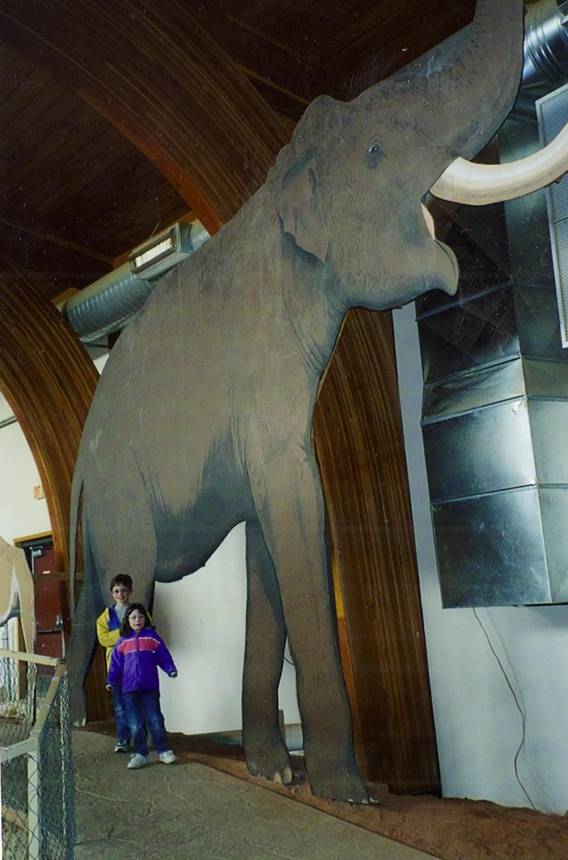
This weeks challenge was to figure out which, in the picture below, was a mammoth, and which was a mastodon. This weeks challenge was correctly guessed by two people, both Ilyssa A. and Masaki K., who both said mammoth on the left and mastodon on the right.  However, how can you differentiate between the two?  Obvious, we have two super-sleuth paleontologists on our hands who can differentiate, but I'm guessing that the vast majority of you might have trouble.  So here is a quick Mammoth Vs. Mastodon Guide, with just a few helpful ways to differentiate between the two.
A size comparison of a mammoth and a human, myself, at the excellent zoo called The Living Desert in California.  Photo Credit: Julie Neher
Check in a few hours for this weeks challenge!

Tuesday, July 31, 2012

Animals of South Dakota: Part 1

Hypothetically, let's say that you are taking a trip up to South Dakota from where I live in Boulder, Colorado, much like my family did nine years ago, in 2003.  You might be thinking "Ew, South Dakota?  What's there to do there?"  Well, although much of the driving might be boring, there are most definitely a few cool places to stop, as well as cool animals to watch for on the way!  Let's start with the sites.

  1. The Mammoth Site - This is one of my all time favorite Ice Age sites, about 40 minutes south of Custer.  According to their website, "To date 60 mammoths (57 Columbian and 3 woolly) have been discovered as well as 85 other species of animals, plants, and several unidentified insects."  This place is very interesting, and not just to those of my ilk.  Most recently, they have added a replica of the frozen baby mammoth discovered in Siberia named "Lyuba." - http://www.mammothsite.com/
    My sister and I standing next to a Columbian Mammoth cutout at The Mammoth Site
Part of The Mammoth Site
2.  Badlands Petrified Garden - I do not remember if we went to this place, but it definitely looks cool.  It is right around the Badlands National Park.  - http://www.badlandspetrifiedgardens.com/

3.  Reptile Gardens - On the way to the Badlands National Park in Rapid City, we have the awesome Reptile Gardens, which I know for a fact that I have been to as we have pictures of my sister and I next to a couple of massive tortoises.  However, our scanner stopped working, so all I have is this picture of a guy pulling a Steve Irwin-like stunt.  Definitely worth the admission price. - http://www.reptilegardens.com/
4.  Bear Country USA - Also on the way to the Badlands National Park, and just a bit farther than the Reptile Gardens, and also in Rapid City, is Bear Country USA.  I have not been there, but my parents have in I believe 1991.  They said that it is a really cool place, where (surprise surprise) you get to see a bunch of bears.  So that should be exciting! - http://www.bearcountryusa.com/


Friday, July 6, 2012

Cloning the Cheetah: Why Bother?

In an attempt to discover why the cheetah has such a low fertility rate, a team of scientists, including David Wildt and Stephen O'Brien, decided to take a look at blood samples from a number of cheetahs, labeled "Vulnerable" by the IUCN.  What they found was startling, and very worrying; the cheetahs appeared to be dangerously, perilously inbred; they were all practically clones of each other. 

Wildt and O'Brien decided to confirm this hypothesis by taking skin samples from a number of cheetahs, and attempting to graft them onto a number of other cheetahs.  In a healthy population of animals, the skin grafts would be immediately rejected.  This is because the body of the animal who received the skin graft would recognize the skin to be from another individual, a foreign body, and attack it, just as it would attack any foreign body (i.e., germs or bacteria.)  Even in humans, skin grafts are often rejected, even ones from close relatives.
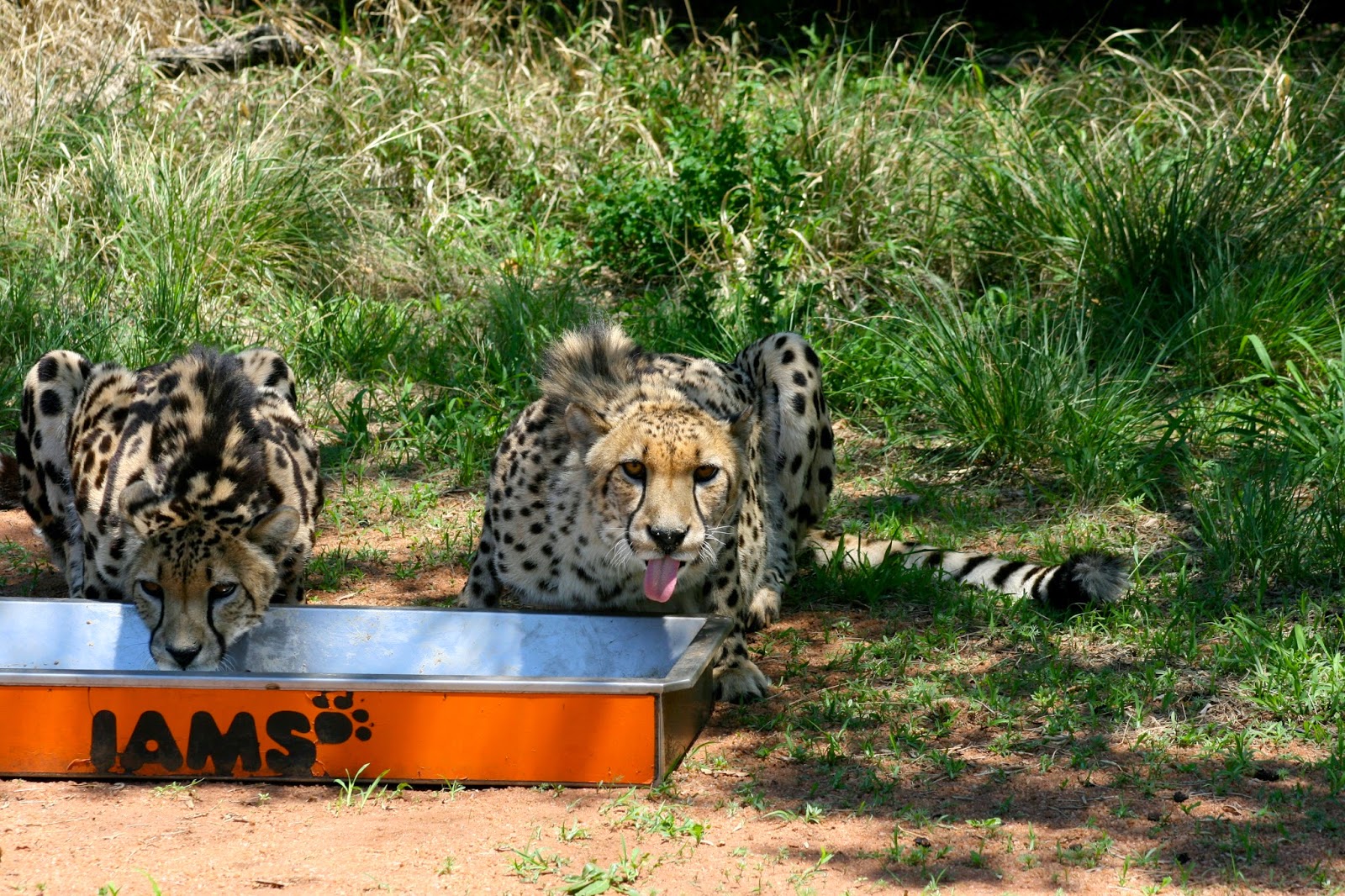
Normally a very majestic looking animal, this particular cheetah seems to have been caught at a bad time.  Photo Credit: Ted and Gail Neher
So when every single one of the cheetah skin grafts were accepted by the other animals, this did not bode well for the cheetah.  This meant the genetic diversity of the cheetah was incredibly, shockingly low.  But why is genetic diversity so important?  Well, without genetic diversity, the DNA of the individuals comprising a given population are very similar.  These individuals essentially become clones of each other, with many similar attributes, most important among them their immune systems.  In a healthy population of, say, cheetahs, say that fifty percent of them are immune to a certain disease, most of them evolving from a common ancestor.  The other fifty percent of the population has absolutely no protection against said disease, and the illness ravages their population.  An unfortunate (and oversimplified) event, to be sure, but fifty percent of the individuals remain to rebuild the population to what it once was.  With the low genetic diversity seen in the cheetah, if a similar disease in the hypothetical above sweeps through Africa, it is quite likely that a much lower percent than fifty would survive.  It is also possible that this disease would so ravage the global population of cheetahs that they would simply be unable to recover from this catastrophic event.
A cheetah scratching a log at the Denver Zoo.  The cheetahs incredibly slender build can help distinguish it from other cats. 
So why is the cheetah so catastrophically inbred?  Most of the time, low genetic diversity is due to a given species having passed through a "bottleneck."  20,000 years ago, cheetahs spanned the entire globe; ranging all over Europe, Asia and Africa, two species of cheetah, or "proto-cheetahs" if you will, even roamed North America (Miracinonyx inexpectatus and M. trumani.)  When the most recent Ice Age drew to a close around 10,000 years ago, the dramatic climatic changes (and likely human influences, as well) resulted in the extinction of much of the world's mammalian megafauna. Researchers think that this mass-extinction managed to knock the cheetah's numbers down to a very small population, likely comprising a mere handful of individuals.  (In fact, I remember reading once that at one time, some people thought that a single pregnant female mother was able to survive, but I don't think that this idea is all that highly regarded anymore).  While the cheetahs were obviously able to build their population numbers and density by a significant amount than that seen 10,000 years ago, this bottleneck came with a price; genetic diversity was, and is, miniscule.

Works Cited:

Friday, June 29, 2012

Animal Spotlight: The Mountain Pygmy Possum

You've probably never heard of the mountain pygmy possum (Burramys parvus); few people have, it being one of Australia's many lesser known marsupials.  One of five extant (opposite of extinct, or still living today) species of pygmy possum, the mountain pygmy possum has a very interesting story about its discovery, a story that we will now look at.

The genus Burramys, the genus the mountain pygmy possum is a part of, also contains three extinct species of possum.   In fact, prior to 1966, the mountain pygmy possum had been described solely from fossils dated from the Pleistocene Epoch.  (The Pleistocene Epoch dates from around 2.5 million years ago to around 10,000 years ago, when the last Ice Age ended.)  It was first described from these Pleistocene fossils by the famous geologist/zoologist/paleontologist Robert Broom in the year 1896, and was assumed to be extinct, just like the other three members of the genus Burramys.  That is until 1966, when one showed up in a ski hut on Mount Hotham, a mountain in New South Wales, southern Australia, and home to the Hotham Alpine Resort.

Since this surprising discovery, scientists have located three populations of the Mountain Pygmy Possum in different spots in southern Australia.  Although it is exciting to discover a species that was previously thought to be extinct, it is saddening to find out that this animal has a wild population of a mere 2,000 individuals, and is labeled "Critically Endangered" by the IUCN.  Means have been taken to protect the mountain pygmy possum, including the so-called "Tunnel of Love," a little possum-path that granted the males better access to the female habitat, and helping to reduce fatal encounters with automobiles.

Works Cited:

Mountain Pygmy Possum. (n.d.). - Just another global2.vic.edu.au weblog. Retrieved June 29, 2012, from http://teacherrsc.global2.vic.edu.au/
Related Posts Plugin for WordPress, Blogger...