Showing posts with label Synapsid. Show all posts

Thursday, August 21, 2014

'Donts and 'Apsids: Ancestral Dinos and Mammals of the Mid-Triassic

When it comes to dinosaurs and mammals, neither had quite yet evolved yet.  Most people consider animals like Herrerasaurus and Eoraptor to be among the oldest known dinosaurs, but others now consider Nyasasaurus to be the oldest, originating from 240 MY old rocks from Tanzania.  Many dinosaurs looked very similar to other, closely related archosaurs, and only extensive research and more specimens will be able to shed light on these ancient critters.

Mammalian ancestors took the form of the now-extinct dicynodonts and the cynodonts, the latter of which include modern mammals, as well.  In modern mammals, you can see how the skull only has a single hole behind the eye (the space where the coronoid process sneaks in between the main part of the skull and the extruding zygomatic arch), making it a synapsid, or "one-holer."  In previous posts, we've talked about primitive, mammal-like animals such as Dimetrodon and Cotylorhynchus.  Both of these critters are synapsids.  Diapsids, or "two-holers" (remember from our recent Latin/Greek Roots post that the root "di" means "two" [click HERE to read that post]), is another large group, and includes everything from crocodiles to dinosaurs, lizards to snakes, and tuataras to birds.  It also includes the archosaurs, a subgrouping of diapsids that are characterized by an additional hole in the skull, bringing the total number of skull holes up to three.  So some diapsids are also archosaurs, such as birds, dinosaurs, and crocodiles.  There's also the anapsids, which are animals with no holes in the skull, such as amphibians and turtles.  Taxonomically, this can get a bit confusing (especially since sometimes an animals classification doesn't correspond to the number of holes that it has at that point in its evolutionary history), and maybe later we can go into greater detail about these different 'apsids, but below we have a nice picture that should help clear things up a little.
Holes in the skull.  On the top left, we have the prehistoric sea turtle Protostega, an anapsid, with no extra holes behind the eye socket.  Below Protostega, we have Prestosuchus, a type of archosaur.  Not only does Prestosuchus have the two holes in the skull behind the eye socket that characterize older diapsids, but it also has a third hole, in front of the eye socket, but behind the nose openings.  On the bottom right, we have Edaphosaurus, a primitive synapsid.  The largest hole in the skull, furthest on the right, is what will one day become the hole that the coronoid process sneaks through, between the zygomatic arch and the rest of the skull.  In the picture above Edaphosaurus, you can see what I'm talking about, with the extinct mammalian synapsid Hyaenodon.  Here, you can see the little nub of the coronoid process between the zygomatic arch and the skull.
As we talked about in that Latin/Greek post that I mentioned above, the name of the primitive, fin-backed synapsid Dimetrodon means "two measures of teeth," referring to the two different types of teeth this animal possesses.  This is a feature known as "heterodonty," a term that means "different teeth."  Most mammals are heterodonts, and most other animals like reptiles are not, but it doesn't always work that way.  Modern cetaceans such as the sperm whale, as well as orcas and dolphins, are homodonts, meaning that they only have one type of tooth in their mouth.  If you look at ancient ancestors of whales, such as Basilosaurus or Zygorhiza, you can see that they have different types of teeth in their mouth.  This condition can be traced all the way back to 50 MY old Pakicetus.
A trio of cetacean skulls.  On the top left, we have Pakicetus, a terrestrial ancestor of the cetaceans, that lived in Pakistan approximately 50 MYA.  Below Pakicetus, we have Zygorhiza, a more derived and fully aquatic cetacean.  In both Pakicetus and Zygorhiza, you can see how the front teeth and back teeth are different, with the front teeth more for gripping prey, and the back teeth perfect for slicing.  On the right, you can see the skull of the modern killer whale, or orca, which has only one type of tooth in their mouth, the conical, gripping teeth.
Then, of course, there are the heterodont reptiles and dinosaurs such as the Cretaceous crocodilian Malawisuchus, and the dinosaurs Heterodontosaurus (literally meaning "different-toothed lizard") and the oviraptorosaur Incisivosaurus.  We also talked about the primitive pterosaur Dimorphodon (two morphs of teeth) in the Latin/Greek post as well.  If you look at the skulls of any of these animals, you can clearly see the different types of teeth in their mouth.  Cynodonts were not merely an aberrant heterodont form amongst a vast sea of closely related homodonts, but instead were precursors to the default heterodont condition seen in mammals.
The skull of Heterodontosaurus, on display at the American Museum of Natural History in New York.  You can see the two different types of teeth in the skull, especially in the lower jaw.
Works Cited:

Tuesday, June 24, 2014

Moenkopi and Lykins: The Mid-Triassic in Western North America

In this post, we continue with out exploration of the Mid-Triassic, 240 MYA.  In this post, we look at the Moenkopi and Lykins Formations of North America, and see what they can tell us about this ancient time.  We also delve a bit into the evolution of fin-backs and sails as display structures, like you can see in the picture below.

In the Moenkopi Formation of North America, we can gain a more complete understanding of the terrestrial fauna of this time period.  We already discussed the rauisuchian Ticinosuchus and the protorosaur Macrocnemus from Monte San Giorgio, as well as the large temnospondyl amphibian Eocyclotosaurus from Grès à Voltzia, but there were lots of other very exciting animals alive back then as well.  Arizonasaurus, a poposaurid archosaur, was likely one of the top predators, and had a back adorned by a Spinosaurus-like sail, similar to the sail seen in the more primitive German archosaur Ctenosauriscus.

We talked about the poposaurs in a recent post which you can read by clicking HERE.  The poposaurs, as well as the rauisuchians, were both members of a large group that many scientists refer to as "pseudosuchians."  These animals were crocodilian in nature, and fairly closely related to them.  But some pseudosuchians, including some rauisuchians and poposaurs, actually evolved a body design similar to some types of dinosaurs, where they could walk on either two or four feet.

Let's jump back to the sails on the back of Arizonasaurus, Ctenosauriscus, and Spinosaurus.  The first two are fairly closely related to each other, but Spinosaurus is not closely related at all, separated by around 150 MY of geologic time.  The question is, why would these animals have convergently evolved these sails on their backs?  The orthodox answer is that the sails help the animal thermoregulate, that by turning the sail towards or away from the sun, it would help the animal warm up or cool off.  Similar ideas have been proposed for other animals that feature similar anatomical structures, such as Stegosaurus with its double row of plates down its back, or the primitive synapsids Dimetrodon and Edaphosaurus.
A model of a juvenile Stegosaurus from the Morrison Natural History Museum.  Other stegosaurs that are very closely related, such as Kentrosaurus and Wuerhosaurus, have very different shaped plates, and a different amount of plates, as well.
This idea has some major flaws, however, as argued by paleontologist Dr. Robert Bakker in his excellent and influential book "The Dinosaur Heresies."  In the book, Bakker points out that very close relatives of these sail-animals don't have these strange fins on their back.  If the thermoregulation theory is accepted, then that would suggest that these very closely related animals had very different thermoregulatory needs.  For example, Bakker points out that the primitive synapsids Dimetrodon and Sphenacodon are very closely related to each other, and most of their anatomy is very similar, other than the fact that Dimetrodon has that enormous sail on its back, and Sphenacodon has only a very slight elongation of its vertebrae.  If we accept the thermoregulatory hypothesis at face value, it would imply that, despite being very similar in anatomy and lifestyle, for whatever reason Dimetrodon and Sphenacodon had drastically different thermoregulatory needs.  Below, we have a chart showing a sail-back on the left with a closely related animal on the right, this one lacking a sail.

So what do we propose instead?  Most likely a means of attracting a mate.  In animals today, it is display structures and behavior pertaining to courtship that changes the most.  An excellent example of this is the birds of paradise from New Guinea, which we discussed in greater depth in a post with a similar focus, in regards to the plates of Stegosaurus, which you can read HERE.

Sharks, such as the very strange-looking Hybodus, have also been discovered in the Moenkopi Formation.

Where I live in Colorado, the Lykins Formation is approximately contemporaneous with the Moenkopi Formation.  The Lykins Formation isn't the most exciting of Colorado's geologic formations (at least not for people interested in fossils or excitement), but stromatolites can be found in some areas of the formation.  Stromatolites are layers of wavy and convoluted cyanobacteria that sometimes form in areas of shallow water.  Cyanobacteria by themselves aren't very big, as they are simply single-celled photosynthetic bacteria.  However, together, the gelatinous secretions they produce is enough to trap the sediment that settles out of the water, forming visible laminations that sometimes fossilize.

Stromatolites were much more common prior to the Cambrian Explosion approximately 500 MYA, as back then there wasn't really anything that could eat it.  Believe it or not, layers of cyanobacteria are notoriously bad at running away from herbivores, even something as slow as a snail or a slug.  Today, stromatolites are relatively rare, especially considering their past abundance, but you can still find them in isolated areas like Shark Bay, Australia, and Lake Salda in Turkey.  Most stromatolites form in areas that discourage herbivore grazing.  Shark Bay and Lake Salda are both hypersaline areas, places where most herbivores simply don't want to go (especially slugs and snails).  More recently, stromatolite-like growths were found living in an abandoned asbestos mine in Yukon, Canada.  This indicates to us that the parts of the Lykins Formation in which the stromatolites are found were likely not conducive to supporting herbivores, perhaps also due to hypersaline conditions.

Join us soon for our next post, in which we look at ancestors of both dinosaurs and mammals that were alive during this time!  We will also do a little investigating into different types of dentition, so stay tuned!

Works Cited:

Friday, June 6, 2014

Bi Di Miss American Pie: Number Two Greek and Latin Roots!

A little while ago, I started a new series all about the Latin and Greek roots in the scientific names of different animals!  IN THE LAST POST, we examined animals with the Greek and Latin roots for "one," and today, we are going to kick it up a notch: exactly one notch, to be precise!  Today, we are going to examine the roots for the word "two!"  Let's begin with the cardinal (i.e. one, two three, etc.) form in Greek!  There are actually several roots that work here, but the one most commonly seen in binomial nomenclature is the root "di!"  Let's DIve right in!

  • Our first "di" today is a small flying creature called Dimorphodon, a member of the extinct group of reptiles called pterosaurs.  The name "Dimorphodon" comes from three roots, "di," "morph," and "don."  "Di," of course, means "two."  In this context, the root word "morph" means "form."  In mythology and fantasty, a being that can take more than one form is often said to be able to morph their appearance.  Finally, the root word "don" is one of my favorites (and is used a whole lot in giving animals their scientific names): it means "tooth."  Altogether now: two-form tooth.  This name refers to the fact that Dimorphodon actually has two different types of teeth in its jaw.  For mammals, that's nothing special, but amongst reptiles, that is pretty rare!

  • Dimetrodon-another animal with two kinds of teeth!  "Di" and "don" still mean the same thing as they did in Dimorphodon (above), but there is a new root in between: "metro."  For this root, think of the term "metric."  The name "Dimetrodon" actually means "two measures of teeth!"  Dimetrodon's two types of teeth would, in the groups that it is ancestral to, one day evolve to become the varied types of teeth that we see in the mouths of mammals!  Dimetrodon is more closely related to mammals than it is to any group of living reptile, and all of us mammals did evolve from a Dimetrodon-like ancestor!  So remember, if anyone ever tells you that Dimetrodon is a dinosaur, tell them that Dimetrodon actually lived around 40 million years before the first dinosaur ever walked the Earth!  That'll show them.
Dimetrodon (left) attacks the primitive amphibian Eryops.  Much like in the skull of Dimorphodon, you can clearly see the much larger teeth in the front of the skull and the smaller teeth in the back of the skull of Dimetrodon.
  • Let's travel forward to the Late Cretaceous Period, time of Tyrannosaurus and Triceratops, to meet Didelphodon, a primitive mammal about the size of the living Virginia opossum!  As a matter of fact, it is from the opossum that Didelphodon gets its name: "Didelphodon" translates to "opossum tooth," as Didelphis is the genus name for the Virginia opossum and several related species of opossum!  In turn, "Didelphis" means "double womb," which presumably refers to the fact that the opossum, like all marsupials, has its internal reproductive tracts where the baby will develop for a bit, and its external pouch, where the baby will develop until full term.  

  • A fourth animal with "two" and "tooth" in its name is Diprotodon!  The middle root, "pro," in this name means "forward," like the word "proceed."  So the name "Diprotodon" actually means "two forward teeth."  A quick examination of the skull of this massive mammal quickly reveals why!  Although it looks like it might be some sort of ungodly large rodent, Diprotodon is actually a hippopotamus-sized wombat, the largest marsupial known to have walked the Earth!

  • Diceratops is a genus of ceratopsian dinosaur that is often considered to actually be a Triceratops.  The name, which means "two-horned face," was later discovered to already belong to a type of insect, and changed to the name Nedoceratops.  Some other paleontologists believe that Nedoceratops is really the same animal as Triceratops, but I don't really know enough about Nedoceratops to have an informed opinion on the matter.  However, paleontologist Jack Horner believes that Nedoceratops is an intermediate growth form between Triceratops and Torosaurus, and since I don't agree with his ideas of Triceratops ontogeny and that I think Triceratops and Torosaurus are definitely distinct dinosaurs, that leads me to suspect that Nedoceratops is more likely distinct, and certainly doesn't bridge the gap between Triceratops and Torosaurus.

  • The name of Diplodocus, which means "double beam" originates from the two rows of chevron that are on the underside of the animal.  This was originally thought to be a feature unique to Diplodocus, a defining characteristic that would set it apart from other closely related sauropods.  Since Diplodocus was named by paleontologist Othniel Charles Marsh in the late 1800s, this feature has since been discovered on a number of other sauropods, including Barosaurus, also from the Morrison Formation, like Diplodocus.

  • Dilophosaurus, one of the stars of the original Jurassic Park movie, gets its name from the two crests on its head.  Last time, we met Monolophosaurus, which means "single-crested lizard."  Therefore, Dilophosaurus means "two-crested lizard!"  

While it is the Greek cardinal root for "two" that is used most frequently in binomial nomenclature, it is the Latin root that is most often used for multiples (i.e. once, twice, thrice, etc.), the root "bi."  You can probably think of several words right off the top of your head that use this root!  In fact, the word "biped," used to describe creatures that walk on two feet (as opposed to, say, a quadruped), comes from the two roots "bi" and "ped," with "ped" meaning "foot" in Latin.  So literally, "biped" means "two feet!"  Let's look at a few more!

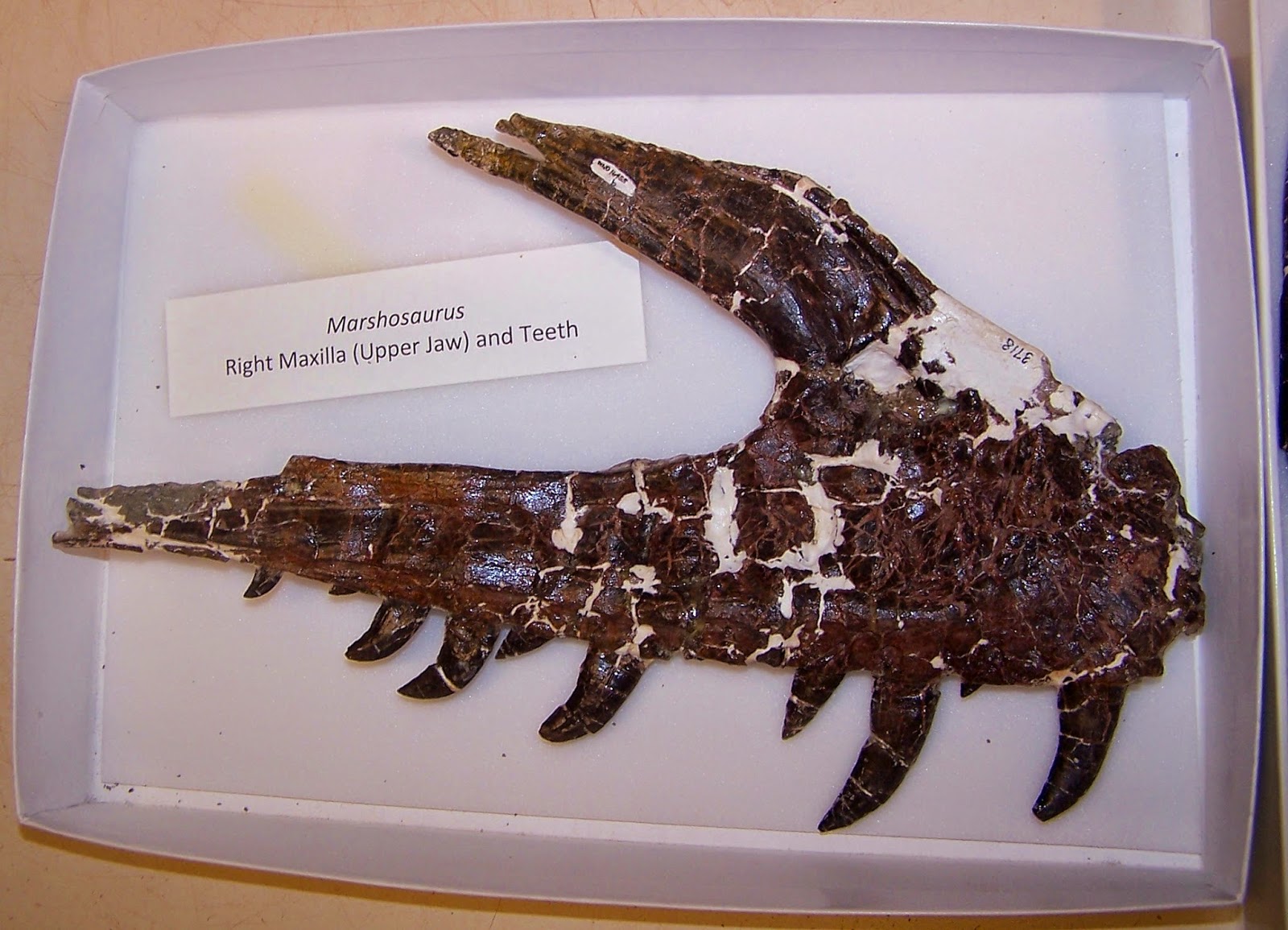
  • Marshosaurus bicentesmus - A theropod dinosaur from the Morrison Formation (one who has received "Full-Post Status," as you can see by clicking HERE).  The exact relationships of Marshosaurus to other theropods isn't exactly clear, but some people think it might even be some sort of primitive coelurosaur, while others think it is more closely related to Megalosaurus and kin.  Regardless of its phylogenetic relationships, the name of Marshosaurus is quite exciting!  The genus name "Marshosaurus" honors the famous paleontologist Othniel Charles Marsh, who did a lot of work in the Morrison Formation.  The species name "bicentesmus" refers to the fact that the species was described in 1976, the bicentennial of the United States.  The bicentennial is, of course, a 200 year anniversary, and the "bi" in the name distinguishes a 200 year anniversary from a 100 year anniversary, or a centennial.
Here are two shots of a specimen of Marshosaurus that were on display in the lab at the Denver Museum of Nature and Science last year.  This first picture is the right maxilla, which would have made up part of the front section of the animals snout.
Here we have more of the same specimen, on display at the same time and the same place.  You can see several vertebrae and ribs in this shot.
  • Baeolophus bicolor - This is the scientific name of the tufted titmouse, a small woodland bird native to much of the eastern half of the United States.  These little birds live in holes in trees that have been abandoned by woodpeckers, and are closely related to chickadees and, of course, the other titmice.  I couldn't figure out what the genus name "Baeolophus" means, but it is pretty apparent that the species name "bicolor" refers to the fact that this little bird is gray on its back, and white on its underside.  Some of the other species in the genus, such as the juniper titmouse (Baeolophus ridgwayi), are simply all gray.  

  • Diceros bicornis - Here we have the scientific name of the black rhinoceros, a "Critically Endangered" species of African rhino.  According to some sources, the black rhino often prefers to eat Acacia leaves, presumably employing its prehensile upper lip to avoid the plants thorns.  The black rhino has pretty poor vision, with much better auditory and olfactory sensing capabilities.  Humans are easily the most dangerous threat to the black rhinoceros, with lions and the spotted hyena occasionally taking young black rhinos as prey, and even more rarely attacking adults.  The scientific name of the black rhinoceros literally means "two-horn two-horn."  As we have already established, both "di" and "bi" are roots that mean two.  Both "ceros" and "corn" are roots that refer to horns: think "Triceratops" for ceros (three-horned face), and "unicorn" for corn (one-horn).  

Works Cited:

Related Posts Plugin for WordPress, Blogger...